
Quick take: Auction properties promise speed and value, but the legal risks are real. Whether you’re a first-time buyer or a seasoned investor, missing a red flag in the legal pack can turn a “bargain” into a costly liability. Once the auctioneer’s hammer falls, you’re legally committed—no cooling-off, no mortgage grace period, and no easy exit.
Make decisions faster. Free trial, review auction/conveyancing packs in 10min. Thereafter just £30 per review. Start your review now
Imagine you’re drawn to a residential auction by the prospect of a fixer-upper in Leeds or a high-yield flat in London. The excitement is palpable, but the legal reality is unforgiving. Sellers often use auctions to offload properties with hidden issues—short leases, structural defects, or unresolved title disputes—knowing buyers have little time for thorough conveyancing checks.
1. Special Conditions: The Hidden Costs
The “Special Conditions of Sale” is where sellers embed extra costs. While General Conditions are standard, Special Conditions can include a buyer’s premium, legal fee contributions, and search fee reimbursements. For example, you might win a terrace house at £100,000, only to discover a 3% buyer’s premium plus VAT, seller’s legal fees, and search costs. Your liability can jump by thousands before you even consider Stamp Duty.
Nuance: These costs aren’t always obvious. Some sellers add further caveats, such as penalties for late completion or requirements to pay for outstanding utility bills. Always read every clause—missing one can mean unexpected financial exposure.
2. Mortgageability: The “Cash Buyers Only” Warning
“Cash Buyers Only” isn’t just marketing—it’s a legal warning. Properties with defects (missing kitchen, bathroom, or legal paperwork) may be unmortgageable. The “Six-Month Rule” means lenders often refuse loans if the seller has owned the property for less than six months. If the legal pack shows a recent purchase, you may be forced to use expensive bridging finance, increasing your liability and risk.
Caveat: Even if a property appears mortgageable, lenders may reject it due to restrictive covenants, short leases, or unresolved planning issues. Always check the legal pack for these red flags.
3. Structural and Planning Blind Spots
Local Authority Searches aren’t just about roadworks—they reveal whether extensions or conversions have proper Building Regulations certificates. Without them, the local authority could require you to remove unauthorized works. Indemnity policies can sometimes cover these risks, but only if you identify the issue before bidding.
Completeness: Some legal packs lack key documents, or provide only partial information. If a pack is missing planning consents or completion certificates, treat it as a warning sign and factor the risk into your decision.
4. Limited Title Guarantee: The Unknowns
A “Limited Title Guarantee” means the seller—often a bank, executor, or receiver—can’t vouch for the property’s history. You may inherit undisclosed charges or third-party claims. Unlike a “Full Title Guarantee,” your legal liability is higher, and you may need title insurance to protect your investment.
Unwildered Context: How Our AI Legal Pack Review Helps
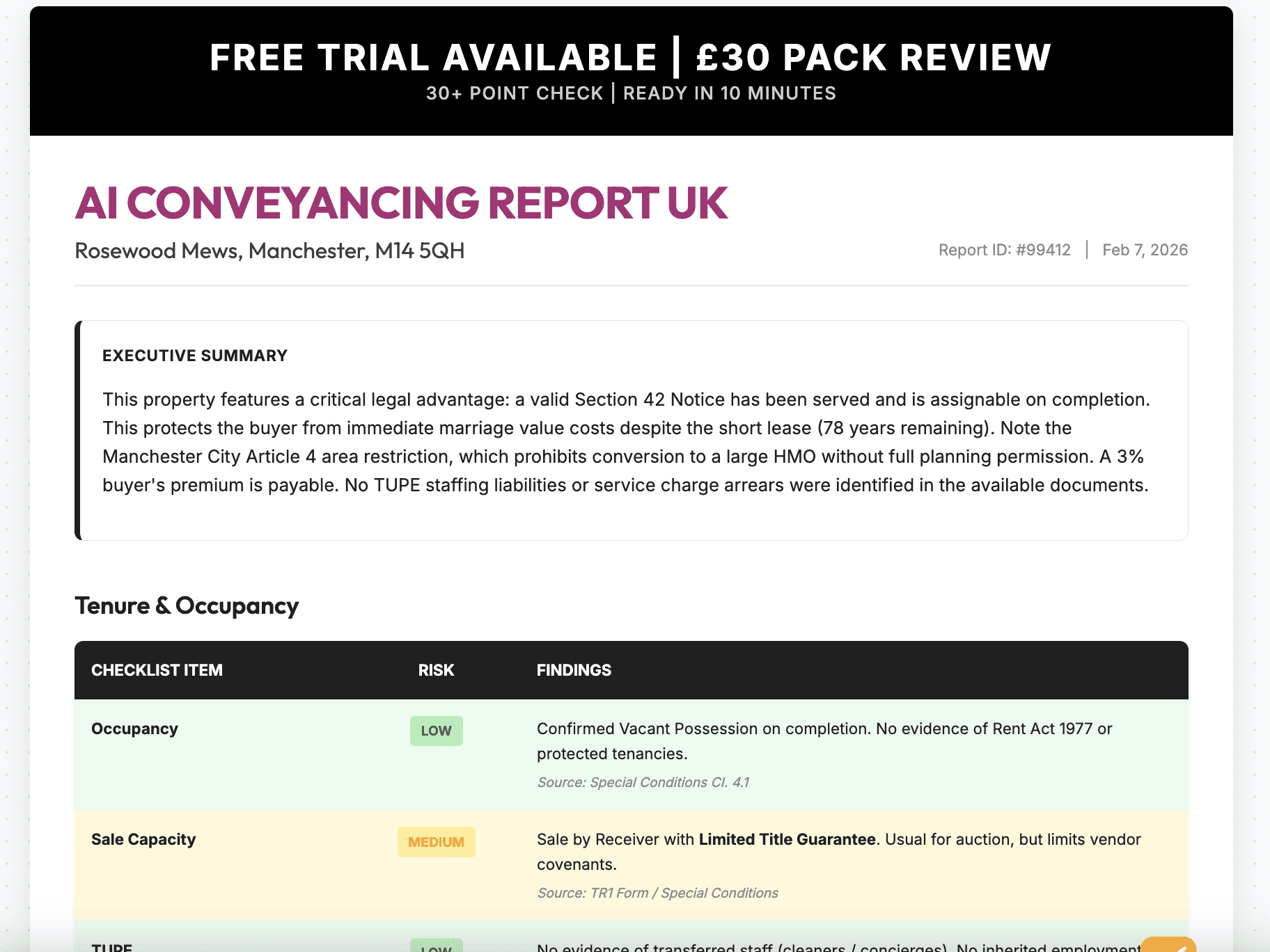
Reviewing a 300-page legal pack is daunting. Unwildered’s AI acts as a preliminary filter, checking each pack against 30+ risk points. We flag:
Financial Liabilities: Buyer’s premiums, legal fee contributions, search fee reimbursements.
Mortgage Risks: Short leases, restrictive covenants, title defects.
Title Issues: Possessory titles, missing guarantees, insurance requirements.
Our AI doesn’t replace solicitors, but it helps you triage deals—so you only send viable properties for final conveyancing, saving money on aborted legal fees.
FAQ
Is an auction legal pack review the same as a survey?
No. A legal pack review checks documents (title deeds, searches, contracts) for legal risks. A survey inspects the property’s physical condition. Both are essential for a complete due diligence process.
Can I pull out if I find something bad after the auction?
No. Once the auction ends, you’re legally bound to complete. Failure means losing your deposit (usually 10%) and facing potential legal action for any loss if the property is resold.
What about ChatGPT?
General AI tools like ChatGPT can summarize text, but they often miss legal nuance and context. Unwildered’s specialized AI is trained on UK property law and conveyancing, cross-referencing legal packs against risk playbooks. While no tool is perfect, our system is designed to spot auction-specific liabilities and legal caveats.
Does Unwildered guarantee to catch every issue?
No. Our AI is a preliminary filter, not a substitute for legal advice. We help you identify obvious risks, but final conveyancing should always be handled by a qualified solicitor.
For related guidance, see our guide to buying commercial property at auction The VAT and dilapidations trap.
For related guidance, see our guide to buying mixed-use property at auction: SDLT and finance pitfalls.
Disclaimer: This article is general information, not financial, tax, or legal advice.
