If you look after an older person and need a break, start with the council’s adult social care team. In England, the council may fund all or part of the replacement care after an assessment. If the council charges for care provided to the older person so you can take a break, the charge is theirs. The council cannot charge you for that care simply because you are their carer. Care Act 2014, section 14 · NHS guide to carers’ breaks
1. Which assessments should I ask for?
Ask for a carer’s assessment for you and a care needs assessment for the person you support. If you already have assessments, explain what has changed and ask for a review. Describe the tasks someone needs to cover while you are away, including help with meals, getting to the toilet or supervision overnight. Say whether an afternoon visit at home, a day service or a short stay in a care home would give you enough time off. Find the council’s assessment service · Care and support statutory guidance, chapter 6
2. Ask whose care it is and how the charge was worked out
Your carer’s assessment may identify the need for a break. If a worker then comes to look after your dad, he receives the care. If the council charges, it assesses his finances to work out the contribution. Support provided to you personally, such as a gym class arranged as carer support, can fall under a separate charging policy. A private booking has its own contract, so check whose name is on it before signing. Statutory guidance, paragraphs 8.49 to 8.55 and 11.42 to 11.46
For a short care-home stay, ask which charging rules the council is using and which costs or assets it has counted. For stays of up to eight weeks, the council may use the rules for care outside a care home. If the person is classed as a temporary resident and expects to return home, their main or only home is usually left out of the financial assessment. Ask for the calculation in writing. Statutory guidance, paragraph 8.34
Worked example. The care home asks you to sign while the council is assessing your dad
You need six nights of cover while you recover from an operation. The home has a room and sends you a booking form, but the council has not told you what it will fund. Ask adult social care who will book the stay, whose contribution it is assessing and when you will get a written decision. Ask the home whether the price includes transport and what you would owe if you signed or cancelled. Keep those questions separate from the need to arrange safe cover in time.
How Caira can help
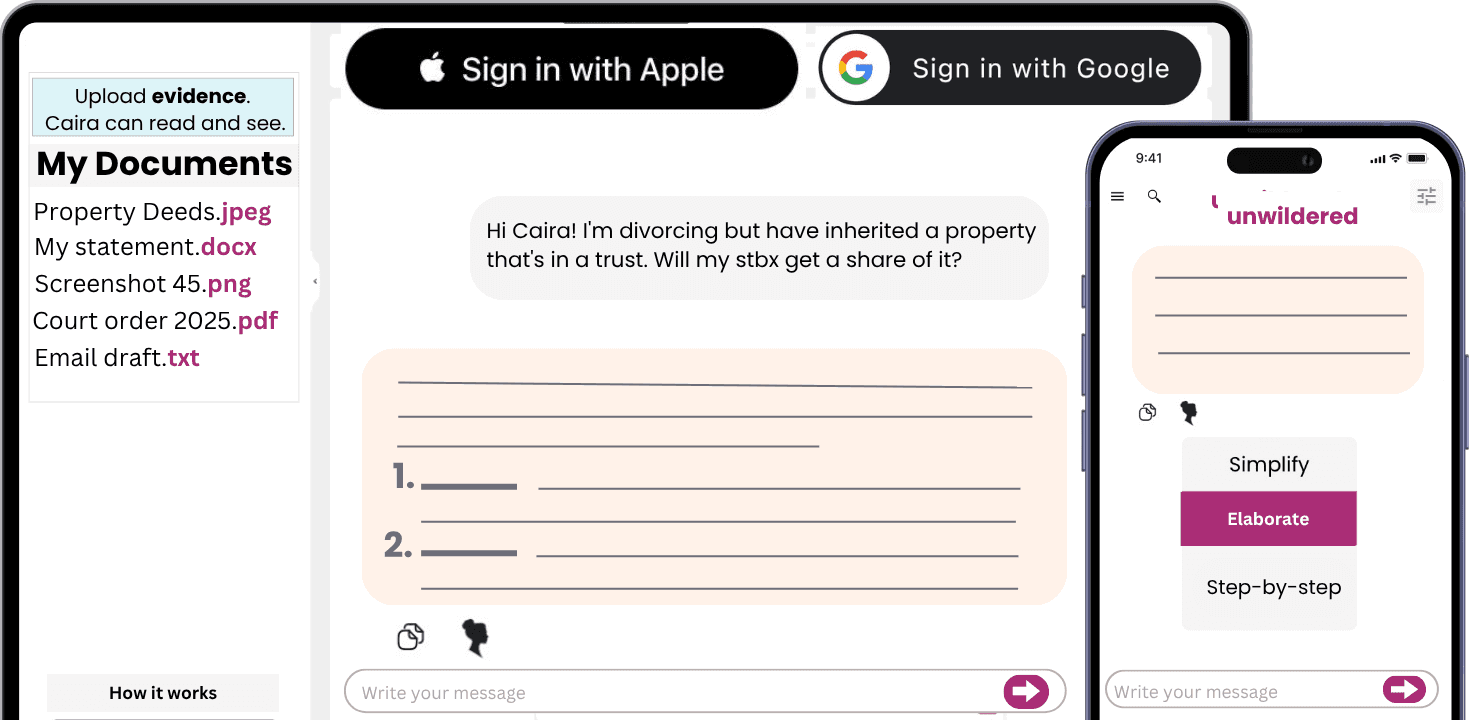
Caira, Unwildered’s AI-powered legal assistant, can review a council charging letter or support plan with personal details removed. Ask it to draft a short email requesting the written calculation or a list of questions to take to a review.
3. What should I check about payment before booking?
If the council agrees to fund respite, ask whether it will arrange the service or whether you can use a direct payment to arrange the agreed care. Confirm the hours or nights covered, any contribution and who will book the provider. If you are paying privately, get a written price and check whether transport, overnight support or cancellations cost extra. Local carers’ services may also know about grants or free sitting services. GOV.UK direct payments · NHS respite funding options
If the person already receives NHS continuing healthcare or section 117 mental health aftercare, ask their care coordinator whether the requested break is covered by that plan. Care within those schemes is free. For someone with complex health needs who has no such plan, ask a health or social care professional about a continuing healthcare assessment. NHS continuing healthcare · NHS section 117 aftercare
If you suddenly cannot provide safe care, call adult social care and say when cover is needed and why it cannot wait. The council can act on urgent needs before the usual assessments are complete. Care Act 2014, section 19
Disclaimer: This article is for general information only and does not constitute financial, legal, tax or medical advice.