
For china cross border service apostille, the strongest first move is usually a clear file. Caira can help build it from uploads. Ask about China law, draft letters or forms, and upload files for review.
Start chatting in 30 seconds
Identify the order, date received, deadline, permission issue and exact remedy sought.
For RMB 10 million at stake, unclear grounds can weaken an otherwise serious appeal.
Appeals usually depend on the record, not a fresh telling of the whole dispute.
Use Caira to organise the decision, evidence bundle and draft grounds checklist.
Cross-border China disputes often stall before anyone reaches the merits. The contract, will, marriage record, company extract, bank statement, or expert report may exist, but the court still has to decide whether the document was served properly, translated properly, and proven in a form it can use. For international families, founders, shareholders, lenders, and foreign companies, the document route can be as important as the claim itself.
The Supreme People’s Court rules on service of judicial documents in foreign civil and commercial cases are the starting point for service questions. The Notarization Law and official apostille updates then matter for evidence and public documents. Since China joined the Apostille Convention and it entered into force for mainland China on 7 November 2023, many public documents moving between China and other contracting states no longer need the older chain of consular legalisation. That does not mean every document is automatically court-ready.
Separate Service From Evidence
Service is about giving a party formal notice of court documents. Evidence formalities are about whether the court can rely on documents that prove a fact. The two overlap, but they are not the same. A foreign defendant may need service through a treaty, diplomatic route, postal route if permitted, agreed method, or other recognised channel. A foreign birth certificate, board resolution, company registry extract, or power of attorney may need an apostille, notarisation, translation, or both.
Do not let the word apostille do too much work. Apostille usually verifies the origin of a public document or signature under the convention framework. It does not prove the truth of every statement inside the document, fix a bad translation, or replace a court’s power to examine relevance and authenticity. Private documents may still require notarisation or other proof depending on how they were created and what the court asks for.
Documents That Often Need Early Review
Foreign marriage, divorce, birth, death, adoption, and name-change records.
Foreign company registry extracts, certificates of incumbency, board resolutions, and authorisations.
Powers of attorney for lawyers or representatives in China litigation.
Foreign court judgments, probate grants, arbitration documents, and settlement agreements.
Bank statements, brokerage records, tax filings, invoices, shipping documents, and audit reports.
Email, chat, electronic signature, cloud records, screenshots, and platform logs.
Bilingual Formality Checklist
Use this working checklist before sending documents to a Chinese lawyer or court-support team:
Document name / 文件名称:
Country or region of issue / 出具国家或地区:
Public or private document / 公文书或私文书:
Purpose in the case / 证明目的:
Apostille needed? / 是否需要附加证明书:
Notarisation needed? / 是否需要公证:
Chinese translation provider / 中文翻译机构:
Original, certified copy, or scan / 原件、认证副本或扫描件:
Deadline or hearing date / 提交期限或开庭日期:
After The Apostille Change
For convention-country public documents, the post-2023 process may be shorter, but the party still has to confirm that the country is a contracting state, that the document type falls within the convention, that the issuing authority is accepted, and that the apostille can be verified. For non-contracting countries, traditional consular authentication may still apply. For Hong Kong, Macao, Taiwan, or documents issued by international organisations, do not assume the same route without checking the specific rule.
Also check the destination and direction of travel. A Chinese document being used abroad may need a different issuing office, apostille path, and translation format from a foreign document being used in a mainland court. Some banks, registries, and arbitral institutions impose their own document standards even when the court rule is more flexible. Keep the court requirement separate from the counterparty or institution requirement.
In litigation, timing matters. If the complaint or defence depends on a foreign document, start formality checks before filing, not after the court asks for correction. If service abroad is needed, build a realistic timeline and avoid tactical promises to clients or counterparties. Service delays can affect hearings, default judgment risk, and settlement leverage, but they rarely disappear because a party is impatient.
Use Case Sources As Practical Examples
China International Commercial Court guidance and published judgments can help identify recurring pain points: powers of attorney, foreign company identity, translated contracts, evidence generated overseas, and disputes over whether a party was properly notified. They should not be treated as a universal formality template. Local court practice, treaty route, document origin, and case type may change what is needed.
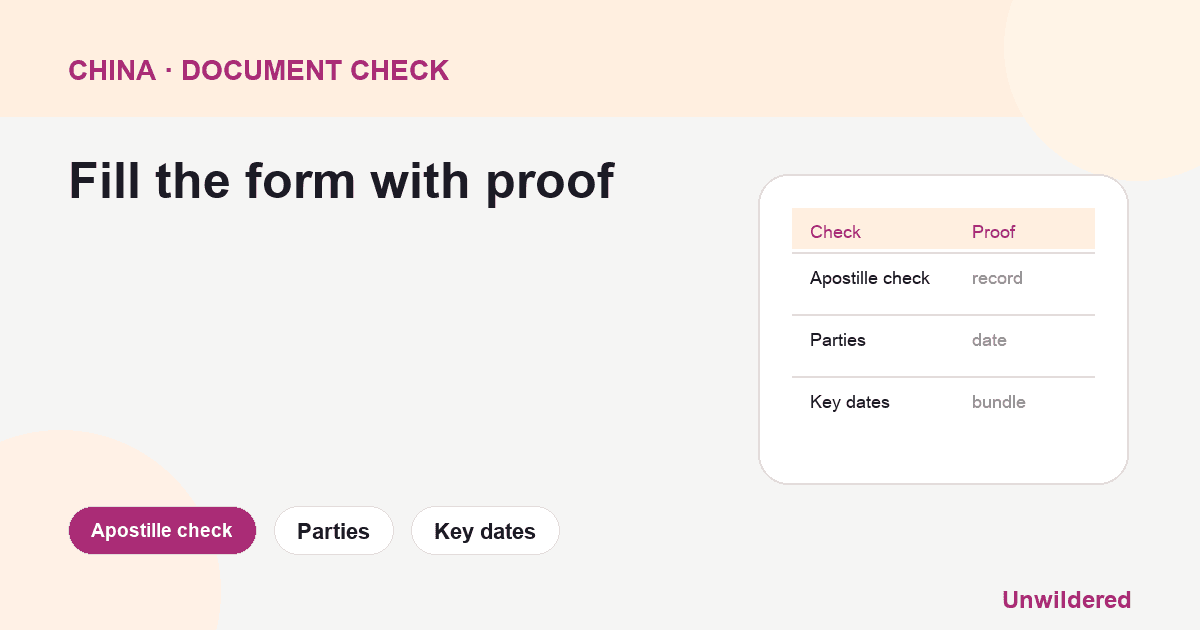
The safest workflow is to create a document matrix. For each document, record what fact it proves, where it was issued, who signed it, what formalities have been completed, what translation exists, and what remains uncertain. Then ask Caira to classify the uncertainty before filing or relying on the document. That approach will not guarantee admissibility, but it reduces the chance that a strong claim is slowed by avoidable document defects.
Sources
Ministry of Foreign Affairs: Apostille Convention guidance
Supreme People’s Court: foreign civil and commercial service rules
National People’s Congress law database: Notarization Law
This article is general information, not legal, financial, medical or tax advice.
