
Working on China Divorce Spouse Not Shareholder? Upload the relevant files to Caira and turn the issue into a practical document checklist. Ask about China law, draft letters or forms, and upload files for review.
Start chatting in 30 seconds
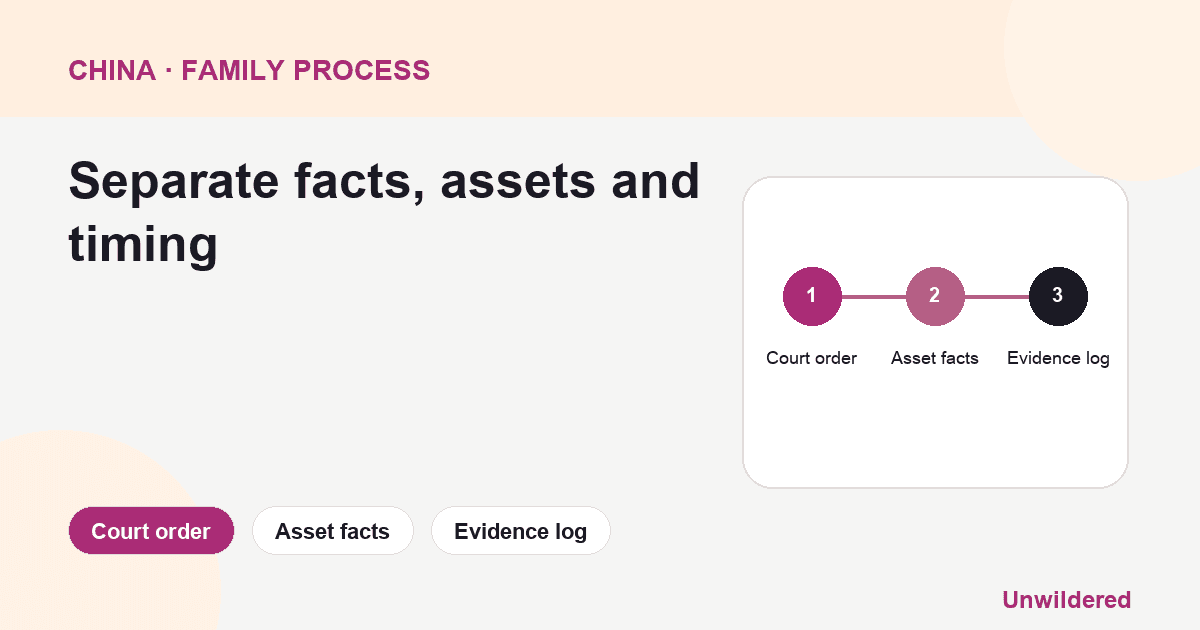
Build a disclosure map: assets, income, debts, companies, property and children’s costs.
For RMB 10 million in family wealth, lifestyle evidence should be tied to documents.
Separate agreed facts, disputed facts and missing records.
Use Caira to draft evidence requests and organise uploaded financial files.
In a China divorce involving a private company, one spouse may say the shares are in my name, while the other says the value was built during the marriage. Both statements can be partly true. The non-shareholder spouse does not automatically become a company shareholder just because the equity may be marital property. The practical dispute is usually about value, transfer restrictions, shareholder consent, compensation, and whether a buyout can be documented without damaging the company or third-party rights.
The official source stack starts with the Civil Code for marital-property division and divorce principles, the Company Law for shareholder and governance rules, and the Supreme People’s Court marriage-family interpretation for how limited-company equity may be handled when one spouse is not a shareholder. Court databases are useful as examples of document fights, but they should not be treated as formulas for valuation or not automatic outcomes.
Do Not Confuse Ownership Labels
There are at least four labels in play. Registered shareholder means the person recorded in company documents or registration materials. Beneficial economic value means the marital estate may claim value created or acquired during marriage. Management control means who holds the seal, bank access, legal representative role, or board position. Transferability means whether a non-shareholder spouse can receive equity or whether compensation is more realistic. A good divorce file keeps these labels separate.
For a limited liability company, other shareholders and the articles of association may matter. A court may need to consider consent, pre-emption rights, price, and whether a transfer would disrupt legal restrictions or third-party rights. For that reason, it is risky to demand simply put me on the register without reviewing the company structure. It is also risky for the shareholder spouse to assume that registration alone defeats a marital-value claim.
Equity And Buyout Evidence File
Company documents: business licence, articles of association, shareholder register, capital contribution records, amendments, and equity-transfer agreements.
Marriage timeline: date of marriage, acquisition date, capital injection dates, separation date, divorce filing date, and any marital-property agreement.
Funding evidence: bank transfers, family funds, loans, reinvested profits, salary, dividends, gifts, inheritance claims, and third-party contributions.
Governance evidence: shareholder resolutions, board records, legal representative role, seal custody, bank authorisations, and management control.
Value evidence: financial statements, tax filings, ledgers, customer contracts, asset lists, liabilities, appraisals, and recent share transfers.
Buyout materials: proposed valuation date, payment schedule, security, tax treatment, release wording, and registration steps if any transfer is approved.
Simplified Chinese Checklist
股权状态:登记股东、实际出资、代持安排、章程限制、其他股东意见。
婚姻时间线:结婚、出资、增资、分居、起诉离婚、财产保全或评估申请。
资金来源:夫妻共同收入、个人财产、借款、赠与、继承、公司利润再投入。
公司文件:营业执照、章程、股东名册、出资证明、股东会决议、转让协议。
估值材料:财务报表、纳税记录、银行流水、重大合同、资产负债和审计资料。
折价补偿:估值基准日、付款期限、担保方式、违约责任、税费和保密条款。
This Chinese checklist is for issue-spotting, not for self-executing a transfer. If a document is controlled by the shareholder spouse or the company accountant, record who holds it and how it may be requested lawfully.
Negotiating Compensation Without Overpromising
A buyout proposal should answer three questions: what is being valued, when it is being valued, and how payment will be made. The subject may be registered equity, marital economic value linked to that equity, dividends, loans, or retained profits. The valuation date may be contested. Payment may need instalments, security, set-off against other assets, or court-supervised terms. Tax and company-registration consequences need separate review.
If the company has loans, can help, unpaid capital, or pledged shares, those liabilities should be visible before anyone treats a headline valuation as distributable value.
Non-shareholder spouses should avoid making demands that would paralyse the company before the legal basis is clear. Shareholder spouses should avoid transferring equity, stripping assets, or changing accounting records after the dispute starts. Those moves can damage credibility and create preservation or compensation arguments. If preservation is needed, get specific advice; speculative freezing or overbroad interference can backfire.
Use Cases As Examples Only
People’s Court Case Database and China Judgments Online materials can show recurring practical issues: missing shareholder records, disputed capital sources, valuation gaps, articles-of-association limits, and attempts to transfer shares during divorce. They cannot tell a spouse that a particular company must be transferred or that a particular discount is fair. Company size, industry, debt, shareholder agreements, tax risk, and personal goodwill all matter.
The realistic goal is a clean negotiation or litigation file. State the registered equity position, the claimed marital connection, the company-law restrictions, the documents still missing, and the proposed route: transfer if legally available, compensation if transfer is impractical, or valuation evidence before either side fixes a number. That will not promise a buyout result, but it will make the dispute understandable to Caira, valuers, and the court.
Sources
Civil Code materials in the official law database
Ministry of Civil Affairs or local civil-affairs guidance
local court guidance for litigated disputes
This article is general information, not legal, financial, medical or tax advice.
