
For china foreign judgment recognition, the strongest first move is usually a clear file. Caira can help build it from uploads. Ask about China law, draft letters or forms, and upload files for review.
Start chatting in 30 seconds
Identify the order, date received, deadline, permission issue and exact remedy sought.
For RMB 10 million at stake, unclear grounds can weaken an otherwise serious appeal.
Appeals usually depend on the record, not a fresh telling of the whole dispute.
Use Caira to organise the decision, evidence bundle and draft grounds checklist.
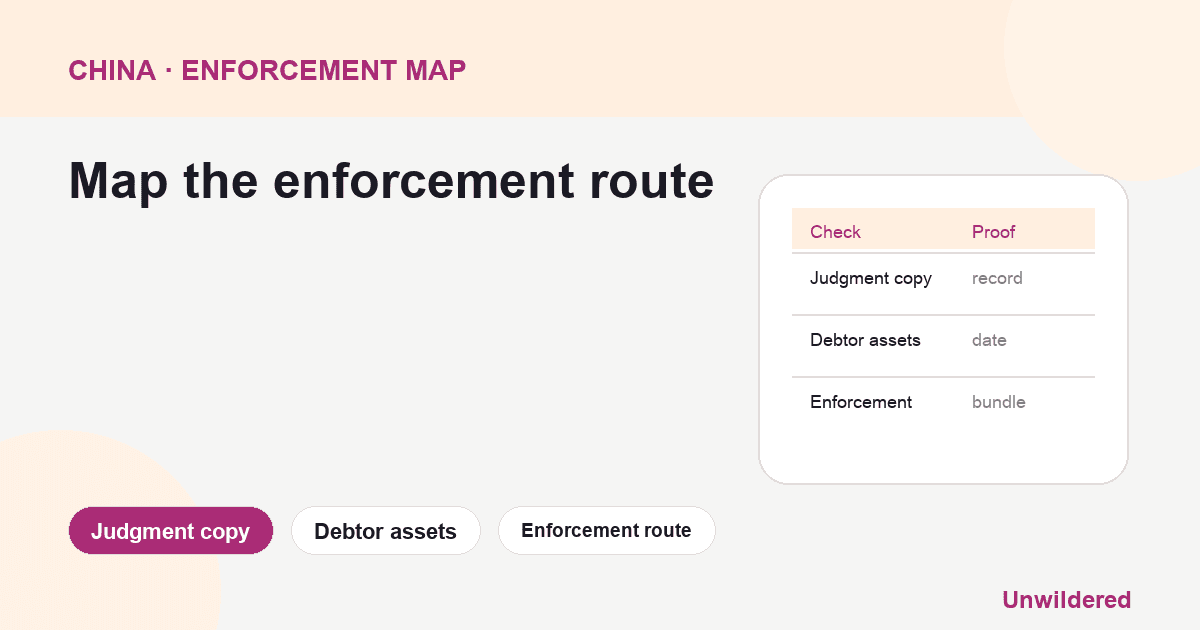
A foreign judgment is not automatically spendable against assets in China. Winning in Singapore, England, the United States, Australia, or another jurisdiction is only the first step. Typically, a China bank, registry, or counterparty will want a court-approved pathway before treating the judgment as enforceable. The practical question splits in two: can the judgment be recognised in China, and if so, do asset clues make enforcement realistic?
For issue-spotting, rely on the Civil Procedure Law, China International Commercial Court portal, and the People’s Court Online Service. Examples of foreign-judgment recognition, such as Supreme People’s Court’s Guiding Case 235 and the People’s Court Case Database, provide useful reference points. These do not guarantee every country or judgment will be enforceable. Recognition depends on the actual judgment, the identity and participation of parties, proper service, finality, and the result of treaty or reciprocity analysis—plus public-policy concerns.
If you need to preserve assets urgently, keep that question separate from the merits of recognition. Preservation demands speed, reliable evidence, and, in some cases, security for potential loss. Recognition, however, requires a properly proved foreign judgment and a clean procedural history.
Separate Recognition From Collection
Don’t start with the debtor’s apartment address. Start with the judgment. The Chinese court needs to see what the foreign court decided, confirmation that the judgment is final and effective where issued, that the defendant had proper notice or a chance to be heard, and that Chinese procedural or public-policy limits are respected. Questions about actually using Chinese assets only come after that analysis.
Create a file with two main tabs. In the recognition tab, outline the foreign case: court, case number, parties, claim type, amount, dates, appeal status, and service history. State whether the judgment is monetary, injunctive, family, insolvency-related, or poses another remedy. The enforcement tab should explain China assets: company shares, bank accounts, receivables, real estate, equipment, trademarks, domain names, or payments owed by Chinese counterparties.
Documents To Prepare
Chinese courts and advisors will insist on formal documentation. Informal summaries help at intake, but authenticated and, where necessary, translated records are required. Before filing, use Caira to confirm notarisation, apostille or consular requirements, translation needs, and which court has jurisdiction.
Judgment package: complete judgment, order, reasons, sealed or certified copy, amount calculation, interest basis, and costs order.
Finality package: certificate of finality or effectiveness, appeal status, limitation notes, and enforcement status in the original jurisdiction.
Service package: proof of service, appearance record, default-judgment materials, notices, and due-process documents.
Party package: creditor identity, debtor identity, company registration, name changes, addresses, and Chinese translations of names.
Authority package: power of attorney, Caira appointment, board authority for corporate creditors, and signatory proof.
Asset package: China company interests, real property clues, bank clues, contract receivables, debtor customers, and preservation history.
Bilingual Filing Checklist
Treat this as an adviser intake list, not a court form:
Foreign judgment / 外国判决: court, case number, date, parties, amount.
Final and effective / 已生效: appeal status, certificate, enforcement period.
Service and defence / 送达与答辩: notice, appearance, default explanation.
China connection / 中国财产线索: debtor domicile, assets, contracts, receivables.
Translations / 翻译: judgment, certificates, identity documents, company records.
Risk points / 风险点: treaty, reciprocity, jurisdiction, public policy, parallel cases.
Choosing The Court And Asset Strategy
Check the competent court early. The right court usually depends on the debtor or asset location and the rules under Chinese procedure. For a corporate debtor, consider registered address, real business location, branches, equity holdings, bank relations, and receivables. With an individual debtor, distinguish between official domicile, habitual residence, property location, and assets held through others.
Be careful not to overstate asset clues. A screenshot, rumor, or an old contract is only a lead. It is not evidence. Track each clue to its source: a land registry extract, company registry record, signed contract, invoice, payment history, database hit, or debtor correspondence. Considering a preservation measure? Get advice on speed and security before filing.
Common Problems
Default judgments need special attention, because courts may scrutinise service and the real chance to defend. Judgments imposing punitive damages, penalties, family-law orders, insolvency effects, arbitration overlap, or public-law elements may face extra hurdles. A foreign settlement agreement is different from a judgment and may need a separate path. A judgment against a group company won’t cover a China affiliate unless the debtor and asset owner are the same, or another supporting legal ground exists.
Best practice is to be conservative. First, assemble the judgment file. Then the asset file. Next, build out the China procedural file. Rely on guiding cases and database examples for framing issues. But don’t promise recognition just on those bases. Creditors who bring a final judgment and credible China asset clues are better placed than those who only have an overseas order and hope to trace wealth later.
This article is general information, not legal, financial, medical or tax advice.
