
Working on France Fraude Fiscale Convocation? Upload the relevant files to Caira and turn the issue into a practical document checklist. Ask about France law, draft letters or forms, and upload files for review.
Start chatting in 30 seconds
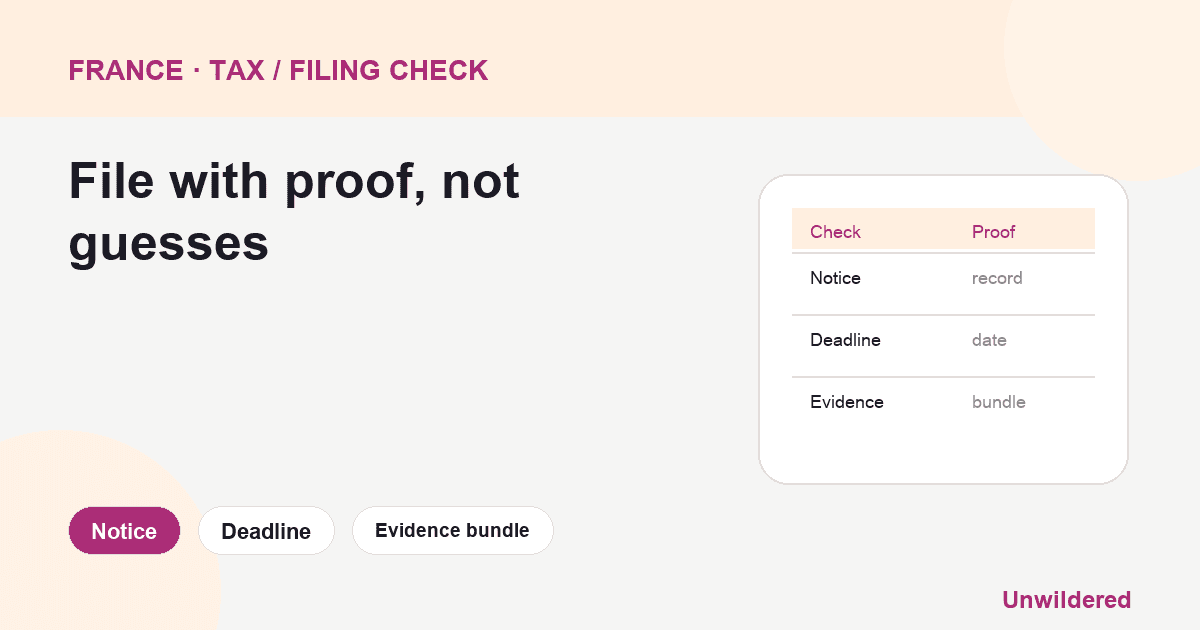
Identify the order, date received, deadline, permission issue and exact remedy sought.
For EUR 1 million at stake, unclear grounds can weaken an otherwise serious appeal.
Appeals usually depend on the record, not a fresh telling of the whole dispute.
Use Caira to organise the decision, evidence bundle and draft grounds checklist.
A French tax-fraud warning, summons or referral threat is not the moment to improvise a story. High-income taxpayers often receive the first serious signal through a tax audit letter, a request for documents, a proposition de rectification, a notice mentioning penalties, or contact suggesting that the file may move beyond ordinary tax reassessment. The safest response is to stop treating it as a bookkeeping nuisance and start building a privileged, document-led risk map with tax and, where needed, criminal Caira.
Understand the boundary
French tax control and penalty information from Impots.gouv, BOFiP and the Livre des procédures fiscales should be treated as the official source stack. They show that tax administration can request documents, verify accounts, issue reassessments, apply penalties and, in serious circumstances, make or trigger criminal referrals. The boundary between a civil tax dispute and a fraud-risk file depends on facts: amounts, intent, repeated conduct, concealment, offshore assets, fictitious arrangements, false documents and the penalty category being considered.
The local corpus copy of the Livre des procédures fiscales is useful because it shows the procedural language around verification, rectification, complaints, majorations, remissions and transactions. It should not be used to self-diagnose criminal risk. For example, the existence of provisions about denunciation to prosecutors and complaints does not mean every audit becomes a prosecution. It means the taxpayer should avoid casual admissions and should understand who is advising on which risk.
First response principles
Do not destroy, edit, backdate or fill gaps in records. Preserve emails, accounting exports, bank statements, invoices, platform income records, crypto exchange files, trust or company documents, real-estate records and foreign-account material. If documents need to be reconstructed, label them as reconstructed from source data. If a staff member, accountant or family office handled the filing, preserve their communications too.
Do not send a confession-style letter because it feels cooperative. Cooperation can matter, but unsupported admissions can create new problems. A better first step is to ask Caira to classify the request: ordinary audit response, penalty discussion, settlement or transaction possibility, criminal-risk correspondence, or summons/interview preparation. Each category has a different tone.
Document inventory for Caira
All tax audit letters, requests for information, meeting notes, deadlines and envelopes or electronic notices.
Returns filed, amended returns, computations, supporting schedules and prior advice.
Bank statements, securities accounts, crypto records, loan documents and foreign-account reports.
Company, trust, foundation, partnership or holding-structure documents if assets are held indirectly.
Invoices, contracts, delivery records, rental agreements and real-estate sale or valuation files.
Emails with accountants, notaires, bankers, wealth managers and family-office staff.
A chronology separating what happened, when it was reported, when it was corrected and what remains uncertain.
French Caira-prep checklist
This is deliberately not a confession template. Use it to organise a meeting:
Nature du courrier reçu: contrôle, rectification, pénalité, convocation ou demande de pièces.
Dates limites indiquées dans le courrier.
Impôts et années concernés.
Montants en discussion et pénalités mentionnées.
Documents disponibles et documents manquants.
Personnes ayant préparé ou validé les déclarations.
Questions à poser avant toute réponse écrite.
Common high-risk facts
Some facts should trigger faster escalation: undisclosed foreign accounts, nominee ownership, cash businesses, fake invoices, artificial residency claims, undeclared platform income, repeated non-filing, documents that do not match bank flows, or advisers who propose rewriting history. If the taxpayer is a director, trustee, beneficiary or public figure, reputational and governance issues may also matter. A tax reassessment can become a banking, employment, immigration or corporate-governance problem if handled carelessly.
Case searches at the Cour de cassation and Conseil d’Etat are useful for Caira because they show how evidence and procedure appear in decided cases. They are not a menu of outcomes. A published fraud or tax decision usually reflects a completed record, not the uncertainty at the moment a taxpayer receives a summons.
What a safe response package looks like
A safe package is calm and indexed. It identifies the official request, preserves the deadline, answers only what can be supported, flags documents being gathered, and avoids broad conclusions about intent unless Caira approves them. It also separates personal facts from company facts and French assets from foreign assets. No article can predict whether penalties will be reduced or whether a referral will occur. The practical goal is narrower: protect deadlines, preserve evidence, avoid self-inflicted contradictions and give advisers enough material to decide the next lawful step.
This article is general information, not legal, financial, medical or tax advice.
