
If germany erbschein is on your desk, start by uploading the notice, agreement, order or correspondence to Caira. Ask about Germany law, draft letters or forms, and upload files for review.
Start chatting in 30 seconds
Collect the will, death record, asset list, debts, family tree and executor correspondence first.
For EUR 1 million in estate assets, missing bank, company or foreign records can delay distribution.
Ask for status and accounts in writing before making accusations.
Use Caira to draft beneficiary, executor or asset-holder document requests.
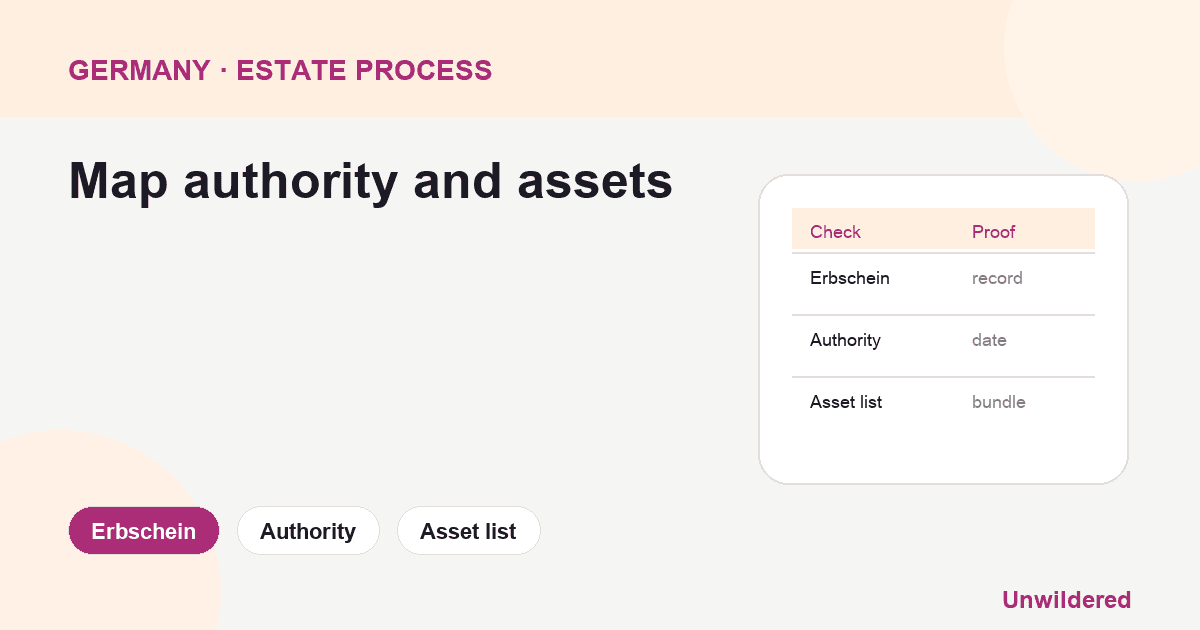
An Erbschein is a German certificate of inheritance. It can help an heir prove inheritance status to banks, land registries, insurers, or other institutions, but it should not be treated as a universal first step after every death. Before asking for an Erbschein, check who is requesting proof, what they will accept, and whether another document may already be enough. A German notarial will, a court-opened will, a European Certificate of Succession, or a foreign estate document may change the practical route.
This guide is for preparation. The official sources validate the statutory concept and the Nachlassgericht or notary workflow, but local court practice, appointments, document formalities, translations, and fees can vary. Use the checklist to organise facts before contacting the competent court, a notary, or an inheritance adviser.
Start with the inheritance basis
First identify whether inheritance is based on a will, inheritance contract, statutory succession, or an uncertain mix. If there is a will, record where the original is, whether it has been submitted to or opened by a court, and whether later documents might exist. If there is no known will, prepare a family tree that shows the spouse or registered partner, children, adopted children, predeceased relatives, parents, siblings, and any earlier marriages where relevant.
Do not hide a document because the family thinks it is outdated. Do not state that no will exists unless the family has made a careful search. The application may involve declarations about what is known, so uncertainty should be marked as uncertainty.
Work out the local route
Many applicants deal with the Nachlassgericht connected to the deceased person’s last residence, while some declarations can be recorded through a German notary. If the deceased lived outside Germany but left German assets, the route may need extra checking. The NRW justice page is a useful official workflow example, but it is not proof that every court uses the same appointment process or document list.
Before booking anything, write down the deceased person’s last habitual residence, last German address if any, nationality if relevant, German assets known so far, and the institution asking for proof. Then ask the court or notary what original documents, certified copies, translations, or apostilles are needed.
Build the document file
A practical Erbschein file usually starts with the death certificate, applicant identity document, last address information, family records, and will-status evidence. Depending on the family facts, add birth certificates, marriage certificates, divorce documents, adoption documents, name-change records, death certificates for predeceased relatives, and contact details for possible heirs.
For cross-border families, make a mini-inventory: document title, country, issuing authority, language, date, name spelling, translation status, apostille or legalisation status, and whether the document is an original or certified copy. Name differences across passports, marriage records, and birth certificates should be flagged early rather than left for the court to discover.
Think about certificate scope
An Erbschein request may need to describe who the heirs are and what share is being certified. Be careful with this step. A sole-heir certificate, joint-heir certificate, or certificate showing particular shares can have different practical consequences. If the shares are unclear, do not invent a percentage to complete paperwork. Mark the issue for the court, notary, or legal adviser.
Also check whether all possible heirs know about the application. If someone disputes the will, rejects the family tree, or may have renounced or disclaimed inheritance, the file is no longer a simple document-preparation exercise.
A short German preparation message
Betreff: Unterlagen zur Vorbereitung eines Erbscheinantrags
Zur Vorbereitung eines möglichen Erbscheinantrags nach dem Tod von [Name] am [Datum] benötige ich die vorhandenen Personenstandsurkunden, Testamente, Informationen zu möglichen Erben und Nachlassunterlagen. Bitte teilen Sie mir auch mit, ob frühere Ehen, Adoptionen, ausländische Urkunden oder weitere letztwillige Verfügungen bekannt sind. Vielen Dank, [Name]
Common mistakes
Common mistakes include applying before checking whether an Erbschein is needed, using a local court page from the wrong state, relying on a copy of a will without knowing where the original is, omitting a predeceased relative, ignoring foreign marriages or divorces, and sending irreplaceable originals without understanding return procedures. Another mistake is focusing only on assets. An Erbschein file is mainly about proving heirship; asset lists are useful, but family and document proof come first.
Where Unwildered fits
Upload the death certificate, will documents, family records, translations, institution request, and any court or notary correspondence. Unwildered can help turn the file into a family-tree checklist, identify missing documents, and prepare focused questions before the application is recorded.
Sources
court/justice Erbschein guidance
Gesetze im Internet
inheritance-tax authority guidance
justice portal
court rules and forms
This article is general information, not legal, financial, medical or tax advice.
