
HK Regulated Tenancy Subdivided Unit can become messy when dates, forms and evidence are scattered. Caira helps organise the record. Ask about Hong Kong law, draft letters or forms, and upload files for review.
Start chatting in 30 seconds
Keep the contract, deposit proof, inventory, photos, messages and payment records together.
For HKD 10 million in rent, repairs or risk of losing the deposit, small missing evidence can matter.
Separate what the agreement says from what actually happened.
Use Caira to draft a landlord, tenant or tribunal-ready document checklist.
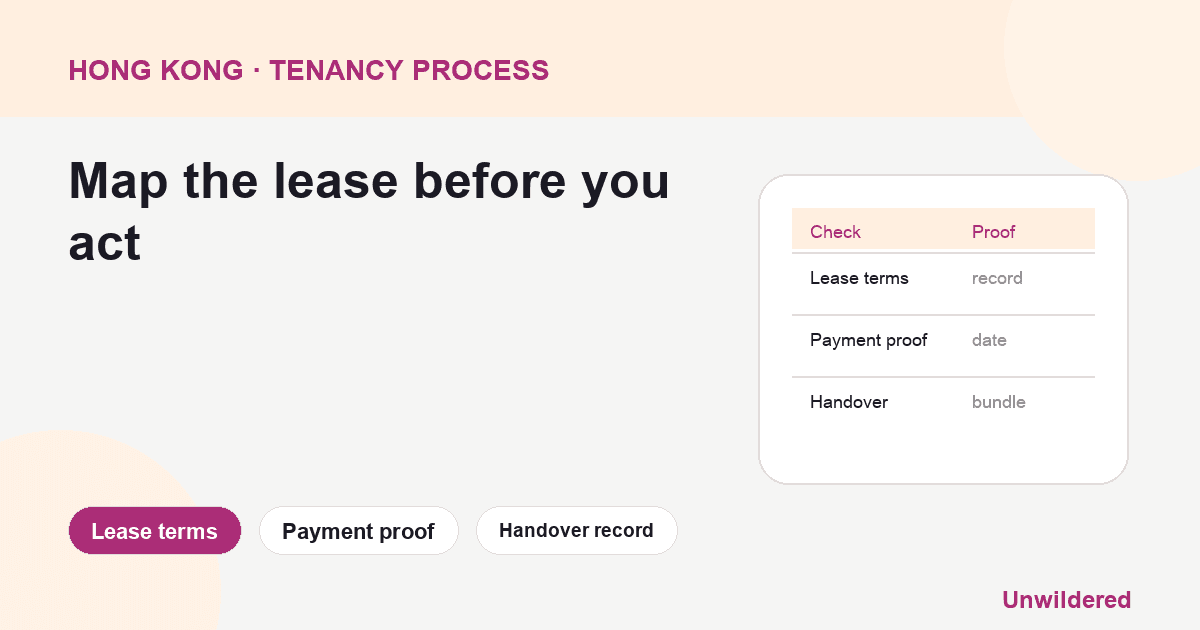
Regulated tenancies of subdivided units are a separate Hong Kong tenancy branch. They should not be handled as if they were ordinary private-flat rentals with only a lease, a deposit receipt, and Form CR109. The Rating and Valuation Department regulated-tenancy pages and the Landlord and Tenant (Consolidation) Ordinance source family are the anchors for this article. The practical task is to identify whether the tenancy really falls within the regulated subdivided-unit regime, then organise the correct forms, notices, tenancy terms, and evidence.
This is a document and workflow guide for tenants, landlords, advisers, and community workers. It does not decide whether a particular room, cubicle, bedspace, or partitioned flat is covered. It also does not apply subdivided-unit protections to ordinary flats without checking the facts.
Confirm the living arrangement
Start with the property. Record the address, building, unit, room or cubicle number, number of occupiers, landlord or principal tenant, rent, deposit, utilities arrangement, and whether the tenant has exclusive use of any space. Save photos of the layout, entrance, meters, shared facilities, kitchen, toilet, and any partitioning. These facts matter because a form workflow cannot fix a mistaken classification.
If the arrangement is an ordinary whole-flat tenancy, a serviced apartment, licensed guesthouse, dormitory, family arrangement, or employment-linked accommodation, do not assume the regulated subdivided-unit form route applies. Mark the issue for current official guidance or advice.
Use the RVD regulated-tenancy source family
The official materials identify RVD regulated-tenancy pages, RVD service pages for Part IVA, and Cap. 7 as the official source family. Use those sources to check which forms, notices, and obligations apply. Local research flags AR forms and regulated-tenancy workflows as distinct from ordinary CR109 records. That distinction should stay visible in the article and in the evidence folder.
Do not download a random form from a forum or copy a landlord template without checking the current RVD page. Regulated-tenancy materials can involve prescribed terms, notice details, rent information, and complaint or enquiry routes. A tenant should keep both the form record and the private evidence record.
Build a tenancy evidence folder
Keep the written tenancy agreement if there is one, any RVD prescribed form or notice, rent receipts, deposit receipt, utility bills, meter readings, landlord messages, repair messages, entry notices, photos, videos, and records of who lives in the unit. If utility charges are shared, keep the calculation method, demand messages, and any bill copies the landlord provides. If rent changes, save the notice, date received, new amount, and how the landlord explained it.
For tenants who communicate mainly in Cantonese or Traditional Chinese, practical labels include 分間單位, 劏房, 規管租賃, 表格AR2, 租金, 按金, 公用服務收費, 水電費, and 業主與租客(綜合)條例. Use labels to organise papers, but keep exact names, dates, and amounts consistent.
Watch the utility-charge file
Subdivided-unit disputes often involve electricity, water, internet, cleaning, or management charges. Do not treat these as side issues. Record whether charges are included in rent, paid separately, based on a meter, divided by headcount, or demanded as a fixed monthly sum. Keep screenshots of payment requests and receipts. If the official rules require particular treatment for public-utility charges, check the current RVD regulated-tenancy guidance before making a claim or defence.
A careful request for documents
A tenant can send: Hi [Landlord/Agent], I am organising my tenancy records for [address/room]. Please send the written tenancy terms, any regulated-tenancy form or notice used for this subdivided unit, rent and deposit receipts, and the basis for any water, electricity, or other utility charges. I would like to keep the RVD regulated-tenancy documents and payment evidence together. Thanks, [Name].
Common mistakes
Common mistakes include using ordinary-tenancy paperwork for a subdivided unit without checking the regulated-tenancy rules, assuming a verbal tenancy means no documents matter, losing rent receipts, failing to record utility-charge calculations, using CR109 language when an AR-form route may be relevant, and making a complaint without dates, amounts, photos, or messages. Landlords can also make mistakes by issuing unclear rent or utility demands, failing to keep consistent records, or using forms from the wrong tenancy type.
Where Unwildered fits
Upload the tenancy agreement, RVD forms or notices, rent receipts, deposit proof, utility bills, meter photos, landlord messages, and room photos. Unwildered can help separate classification questions from document gaps and prepare a concise issue list before contacting RVD, a community adviser, or a Caira.
Official context to check
Hong Kong has useful official market context through the Rating and Valuation Department, but tenancy disputes still turn on documents. Use RVD materials to separate ordinary tenancies, stamping questions, regulated subdivided-unit issues and small-claims evidence.
Sources
Rating and Valuation Department: tenancy matters
Hong Kong e-Legislation: Landlord and Tenant materials
Rating and Valuation Department: regulated tenancies of subdivided units
This article is general information, not legal, financial, medical or tax advice.
