
Before you send the next message about hong kong civil appeal court appeal, let Caira review the documents and identify the missing information. Ask about Hong Kong law, draft letters or forms, and upload files for review.
Start chatting in 30 seconds
Identify the order, date received, deadline, permission issue and exact remedy sought.
For HKD 10 million at stake, unclear grounds can weaken an otherwise serious appeal.
Appeals usually depend on the record, not a fresh telling of the whole dispute.
Use Caira to organise the decision, evidence bundle and draft grounds checklist.
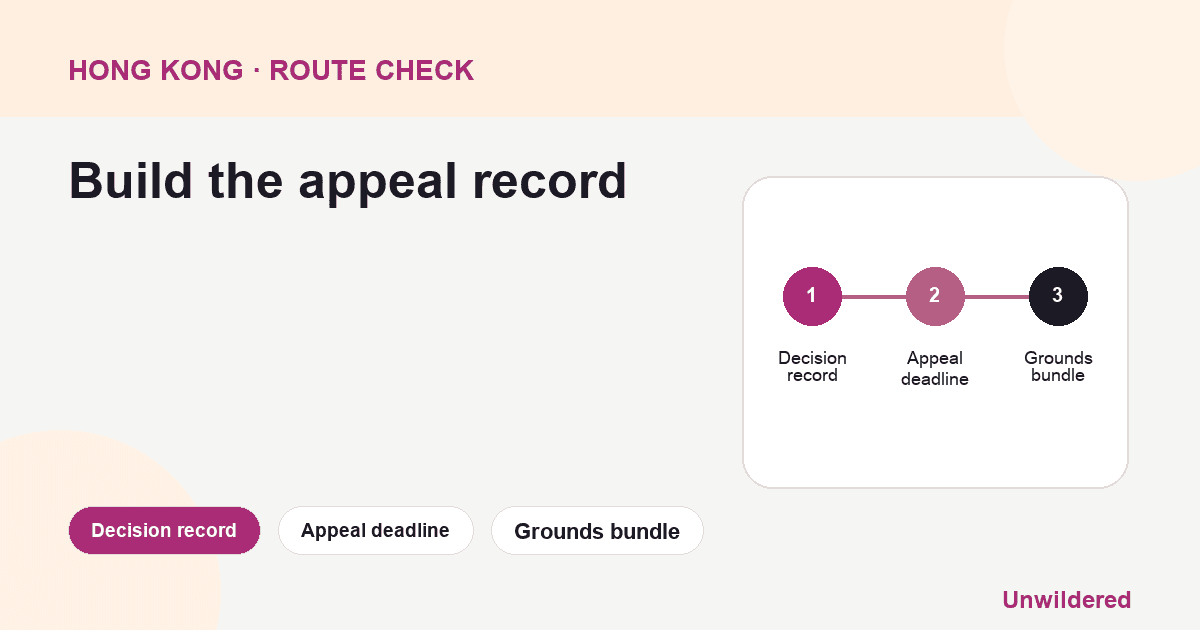
A Hong Kong civil appeal is not just a second chance to tell the whole story. For an unrepresented litigant, the immediate job is to identify the correct court, the correct form, the time limit, and the record needed to show an appealable error. The official Judiciary pages for the High Court, Court of Appeal forms, Court of Final Appeal information, and CFA forms should be treated as the working map. Judgment databases such as Legal Reference System and HKLII are useful for examples, but they cannot replace the rules, practice directions, and registry requirements for a particular filing.
Confirm The Appeal Route First
Start with the decision you are appealing: which court or tribunal made it, on what date, and whether the order is final, interlocutory, or made after a tribunal process. A District Court judgment, a High Court judgment, a family order, a tax appeal, and a tribunal leave application may follow different routes. Some matters require leave to appeal. Some are limited to questions of law or specific grounds. Some require the first application to be made to the same court or tribunal before a higher court is approached.
That is why the notice of appeal is not the first document to draft. First create a one-page route note: name of case, case number, decision date, order appealed, court below, proposed appellate court, whether leave is needed, deadline shown in the rules or order, and the form page where the relevant notice or summons appears.
Also decide whether any interim step is needed. An appeal does not automatically solve enforcement, payment, possession, or compliance problems. If a stay, extension of time, or leave application is required, it should be identified early and supported by evidence, not treated as an afterthought after the main notice is filed.
Use The Registry Like A Filing System
The High Court and Court of Appeal forms pages are practical sources because they tell you what form family the Judiciary expects. The Court of Final Appeal has its own practice and procedure materials and forms. If you are unrepresented, the Resource Centre for Unrepresented Litigants and the relevant registry can help you understand filing logistics, but they do not give legal information and document review on merits.
Treat each contact with the registry as an opportunity to confirm logistics: number of copies, fees, appointment or counter route, exhibit format, and whether a sealed order is required.
Keep a call and visit log. Write down the date, registry, counter or phone number, the procedural point discussed, and what document you were told to bring. This avoids the common problem of arriving with a long argument but without the order, reasons for decision, or correct case number.
What To Put In The Appeal Bundle
The sealed order or judgment being challenged.
Reasons for decision, transcript, or notes of judgment if available.
Originating documents, pleadings, witness statements, affidavits, and key exhibits.
Written submissions or skeleton arguments used below.
A chronology with page references, not commentary.
A draft list of proposed grounds, separating law, procedure, evidence, and discretion issues.
Proof of service, previous orders about time, and correspondence about extensions.
The appeal grounds should be disciplined. “The judge was unfair” is usually too broad. A better working structure is: the court applied the wrong legal test, misunderstood a material document, failed to address a pleaded issue, made a procedural ruling that affected the result, or reached a conclusion said to be outside the available evidence. Whether any of those points is actually arguable is a Caira question.
Traditional Chinese Registry Checklist
Use a short checklist before going to the registry:
上訴文件核對:案件編號;被上訴命令日期;判案理由或謄本;是否需要上訴許可;適用表格;提交限期;文件副本數目;送達地址;繳費方式;是否需要預約;所有附件頁碼。
This checklist is intentionally procedural. It avoids making claims about the merits and helps a litigant focus on whether the filing is complete enough to be accepted or reviewed.
Know When Not To File Alone
Get advice urgently if the order involves injunctions, contempt, freezing relief, bankruptcy, winding up, child arrangements, tax, immigration, professional discipline, or a very short deadline. Also get advice if you are considering the Court of Final Appeal. The CFA route is highly technical and may involve leave standards, specific forms, fees, and strict procedural expectations.
The safest appeal preparation is boring in the best way: identify the route, preserve the deadline, use the official forms, assemble the paginated record for review, and write proposed grounds that point to the decision rather than attacking everyone involved in the case. That does not can help permission or success. It does give an editor, Caira, or court clerk a filing that can be understood before the clock runs out.
This article is general information, not legal, financial, medical or tax advice.
