
If hong kong labour tribunal forms form is on your desk, start by uploading the notice, agreement, order or correspondence to Caira. Ask about Hong Kong law, draft letters or forms, and upload files for review.
Start chatting in 30 seconds
Build a disclosure map: assets, income, debts, companies, property and children’s costs.
For HKD 10 million in family wealth, lifestyle evidence should be tied to documents.
Separate agreed facts, disputed facts and missing records.
Use Caira to draft evidence requests and organise uploaded financial files.
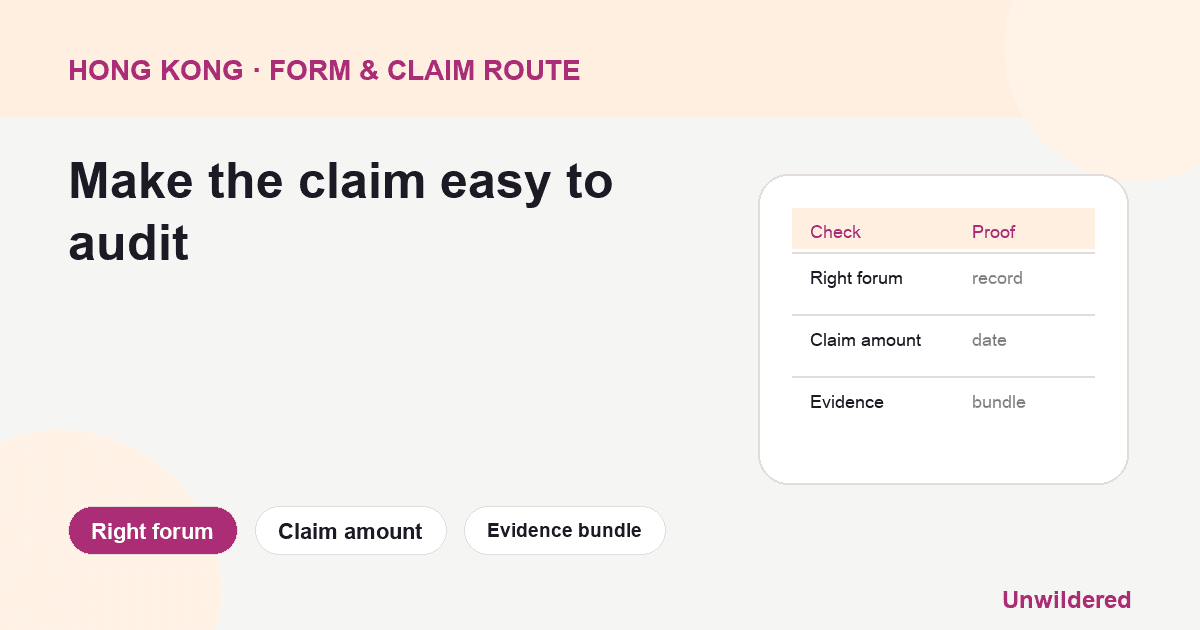
The Hong Kong Labour Tribunal handles many practical money disputes between employees and employers, including unpaid wages, termination payments, payment in lieu of notice, holiday or leave pay, commission, and other employment-related sums where the Tribunal route is appropriate. The Judiciary Labour Tribunal page and forms page are the official starting points. The Labour Department’s Concise Guide to the Employment Ordinance is useful background for understanding wage and final-payment concepts, but the form still needs your own facts and calculations.
This is a preparation guide, not legal information and document review. Check the current Judiciary and Labour Department pages before filing, especially if your dispute involves an independent contractor label, a director relationship, a discrimination issue, an injury claim, insolvency, or facts outside a straightforward employee-employer money dispute.
Mistake 1: naming the employer casually
The respondent should be the legal employer, not only a shop name, manager, brand, restaurant sign, or app chat name. Compare the employment contract, wage records, MPF documents if relevant, payslips, company chop, staff handbook, business card, roster, and bank transfer name. Traditional Chinese labels for your file include 申索人, 僱主, 僱員, 工資, 欠薪, 佣金, 代通知金, 年假薪酬, and 終止僱傭. If you worked for a group of companies, do not guess.
Make a note of who hired you, who paid you, who supervised you, and whose name appears on documents.
Mistake 2: filing a story without a calculation
A wage claim needs numbers. Build a table with columns for item, period, amount claimed, amount paid, amount outstanding, and evidence. Separate basic wages, overtime if claimed, commission, bonus, payment in lieu of notice, untaken leave pay, statutory holiday pay, end-of-year payment if relevant, deductions, and reimbursement. If you are not sure a category applies, label it as a question rather than inflating the claim.
For example: March wages, HKD [amount], paid HKD [amount], outstanding HKD [amount], evidence: payslip and bank record. Repeat for each item. This makes it easier for a tribunal officer, employer, adviser, or mediator to see the dispute.
Mistake 3: weak employment dates
Record the first working day, contract date, probation period, role changes, last working day, termination notice date, and final-payment date. If employment was informal, preserve onboarding messages, rosters, work photos, uniform records, staff chats, manager instructions, customer schedules, and bank transfers. The form should not leave the reader guessing whether you worked for two weeks, two months, or two years.
Mistake 4: relying only on screenshots
Screenshots can help, but they should be organised. Keep full-message exports where possible, sender names, timestamps, and surrounding context. If a manager promised to pay next Friday, include the earlier messages showing what the pay was for. If commission is disputed, keep the commission plan, sales records, client list, approval messages, and any statement of account. If the employer says you resigned, preserve your resignation or termination messages exactly as sent.
Mistake 5: skipping the Labour Department context
Many employment disputes involve conciliation or Labour Department steps before or around tribunal action. Do not invent a route from forum posts. Use the Labour Department’s current guidance and the Judiciary’s Labour Tribunal page to understand the official sequence. If you have already attended conciliation, keep appointment letters, settlement offers, statements, and the outcome record.
A payment request before escalation
A concise note can help clarify the dispute:
Dear [employer], I refer to my employment as [role] from [date] to [date]. My records show that the following sums remain unpaid: [list amounts]. Please pay HKD [total] by [date], or provide a written breakdown explaining any disagreement with supporting payroll records. I reserve all documents and correspondence.
Traditional Chinese version: 本人曾於[日期]至[日期]受僱為[職位]。根據本人紀錄,尚欠以下款項:[列明項目及金額],合共港幣[總額]元。請於[日期]前支付,或以書面列明不同意的原因並提供工資紀錄等證明。
Check settlement wording carefully
If the employer offers settlement, write down exactly what is being paid, when it will be paid, and which claims the payment is meant to resolve. Be careful with broad release wording if you do not understand it. A practical settlement note should match your calculation table, so unpaid wages, notice pay, commission, leave pay, and any reimbursement are not accidentally mixed together or forgotten.
Where Unwildered fits
Upload the contract, payslips, bank records, rosters, staff messages, termination notice, conciliation papers, and your calculation table. Unwildered can help organise the wage file, identify missing employer details, and make the claim narrative easier to review before you use official Labour Tribunal forms.
Sources
Labour Department
Labour Tribunal
Hong Kong e-Legislation: Employment Ordinance
This article is general information, not legal, financial, medical or tax advice.
