
Working on Hong Kong Labour Tribunal Forms? Upload the relevant files to Caira and turn the issue into a practical document checklist. Ask about Hong Kong law, draft letters or forms, and upload files for review.
Start chatting in 30 seconds
Check the dismissal date, deadline, contract, warnings, pay records and messages first.
For HKD 10 million of salary, bonus or severance, a careful chronology can change the negotiation.
Preserve lawful evidence, but avoid taking confidential files you should not access.
Use Caira to build a timeline and draft a response checklist.
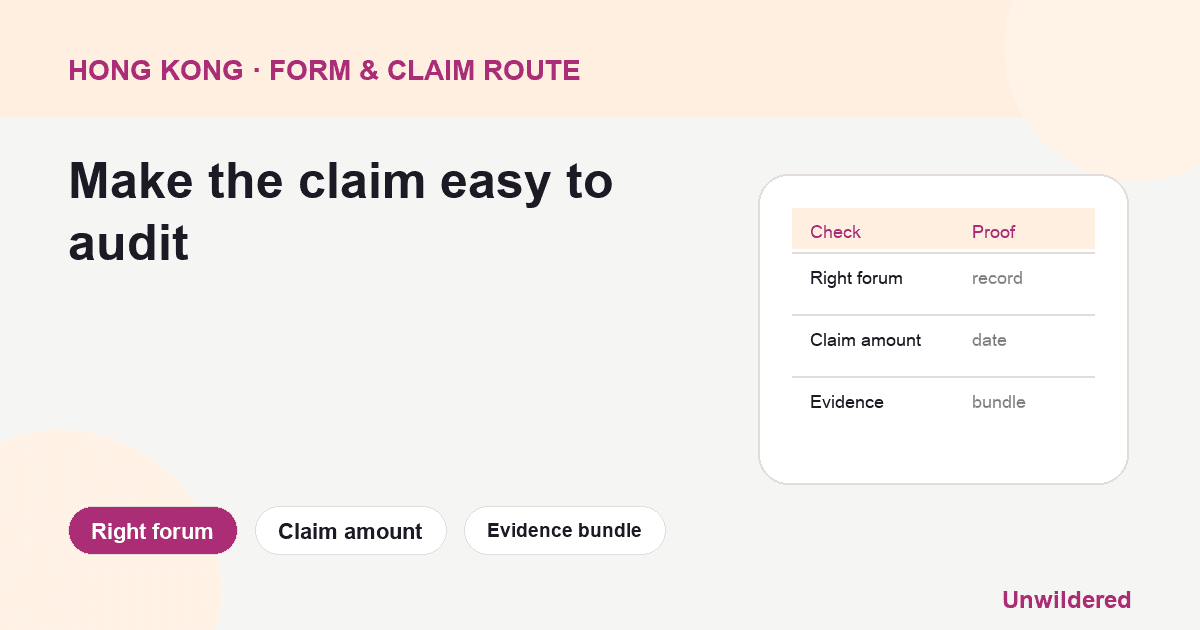
A Labour Tribunal claim is easier to present when the evidence is organised before the form is completed. The form should show who employed you, the employment period, what money is owed, what has been paid, and what documents prove the balance. The official source family for this guide is the Judiciary Labour Tribunal page, the Judiciary forms page, and the Labour Department Concise Guide. Use those sources for current procedural and Employment Ordinance guidance.
Who this is for
This guide is for Hong Kong employees preparing a monetary employment claim, such as unpaid wages, final wages, commission, annual leave pay, statutory holiday pay, payment in lieu of notice, severance payment, or long service payment where relevant. It is not for tenancy disputes, consumer purchases, discrimination complaints, personal injury, criminal allegations, or immigration issues. It also does not decide whether every worker labelled a contractor is legally an employee.
If status is disputed, collect evidence about how the work relationship actually operated.
Do not route wages to Small Claims
Because wage claims involve money, some people assume Small Claims must be the fastest route. That is a risky shortcut. The official materials warn not to route wage claims to Small Claims. Check Labour Department conciliation context and the Labour Tribunal information before deciding the next step. A clean claim uses the correct official route as well as the correct amount.
Identify the employer exactly
The respondent should usually be the legal employer, not simply a supervisor, shop name, restaurant sign, WhatsApp nickname, or payroll contact. Check the employment contract, offer letter, payslips, tax forms, MPF documents if available, bank transfer sender, company chop, HR emails, and staff handbook. If several company names appear, make a note showing who hired you, who supervised you, who paid wages, and who issued termination or resignation documents.
Useful Traditional Chinese labels include 勞資審裁處 for Labour Tribunal, 申索人 for claimant, 僱主 for employer, 僱員 for employee, 欠薪 for unpaid wages, 工資 for wages, 代通知金 for payment in lieu of notice, 年假薪酬 for annual leave pay, and 遣散費 for severance payment.
Build the calculation before the form
Do not ask the tribunal to discover the amount from a pile of screenshots. Create a table with claim item, period, agreed rate, amount due, amount paid, deductions, balance, and supporting document. Separate basic wages from commission, overtime, annual leave pay, statutory holiday pay, end-of-year payment, payment in lieu of notice, severance, long service payment, and reimbursement if relevant. If the employer paid part of the claim, update the table and show the remaining balance.
Prove employment terms and work done
Collect the offer letter, employment contract, wage records, payslips, bank statements, roster, clock-in records, leave records, commission plan, sales reports, work messages, resignation letter, termination letter, and payroll promises. If the employment terms were verbal, the surrounding evidence matters more: messages about salary, rosters showing hours, bank records showing regular wage payments, and manager instructions. Preserve full message threads with dates and sender names.
Write a plain claim narrative
A strong narrative is not a diary of every workplace problem. It can be simple: I worked for [employer] as [role] from [date] to [date]. My wage terms were [terms]. For [period], I was owed HK$[amount]. I received HK$[amount]. The unpaid balance is HK$[amount]. The supporting documents are [contract, payslips, bank records, roster, messages]. Add termination facts only where they affect notice pay, final payment, leave pay, or another claimed item.
A payment request message
If it is safe to make one more written request, keep it factual:
主旨:要求支付欠薪及提供計算明細
[僱主/HR姓名] 您好:本人於 [日期] 至 [日期] 受僱於 [公司名稱],職位為 [職位]。截至今日,本人仍未收到 [期間/項目] 的款項,估算欠款為港幣 [金額] 元。請於 [日期] 前安排付款,或提供公司認為應付金額的計算明細及相關文件。謝謝。[姓名]
Common mistakes
Do not name a manager personally unless that person is truly the employer. Do not merge every employment issue into one unexplained amount. Do not rely on screenshots cropped so tightly that dates and sender names disappear. Do not forget commission plans, rosters, and leave records before losing access to work systems. Do not sign a settlement receipt you do not understand simply because payroll says payment will be faster.
Where Unwildered fits
Upload the employment contract, payslips, bank records, roster, termination messages, HR emails, and calculation table. Unwildered can help turn scattered wage evidence into a chronology and claim checklist before you use official Labour Department or Judiciary channels.
Sources
Labour Department
Labour Tribunal
Hong Kong e-Legislation: Employment Ordinance
This article is general information, not legal, financial, medical or tax advice.
