
Before you send the next message about hong kong probate registry forms form, let Caira review the documents and identify the missing information. Ask about Hong Kong law, draft letters or forms, and upload files for review.
Start chatting in 30 seconds
Collect the will, death record, asset list, debts, family tree and executor correspondence first.
For HKD 10 million in estate assets, missing bank, company or foreign records can delay distribution.
Ask for status and accounts in writing before making accusations.
Use Caira to draft beneficiary, executor or asset-holder document requests.
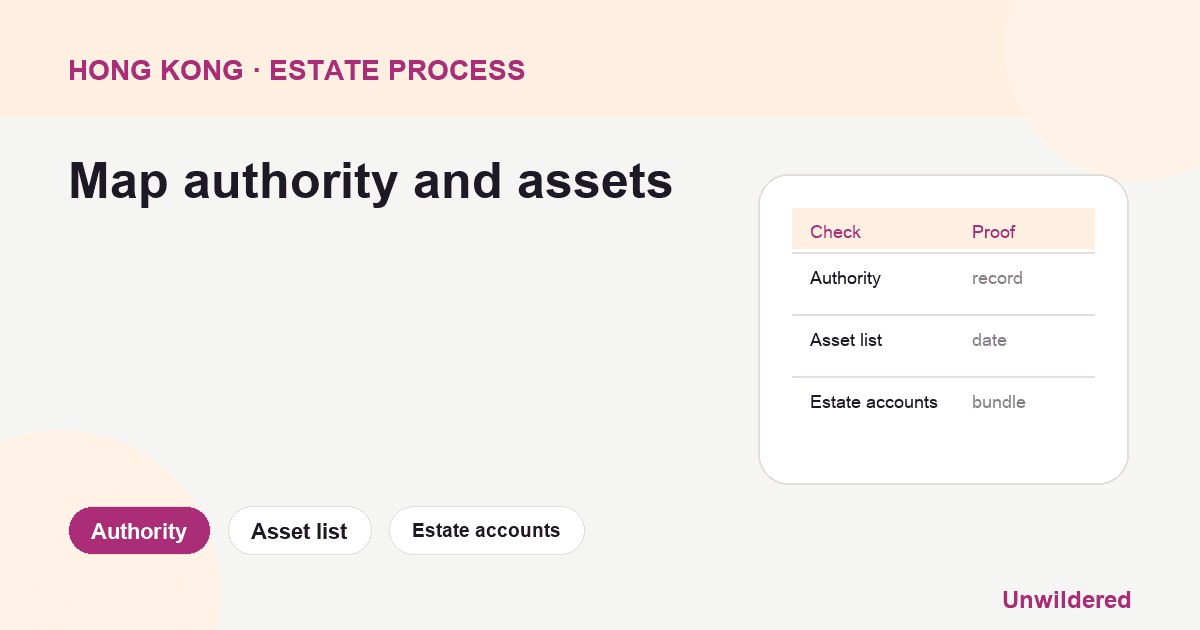
A Hong Kong probate file can become difficult long before anyone argues about inheritance. The Probate Registry workflow needs the right type of grant application, the correct applicant, the death record, will or no-will facts, estate information, and supporting documents. The official source family for this topic is the Judiciary probate guidance, Probate Registry forms page, and the Wills Ordinance source family. This article helps families prepare the file without pretending to decide entitlement.
Use this as a document checklist before contacting the Probate Registry, a Caira, or an adviser. It is not will drafting, tax information and document review, or advice that a particular person must inherit.
Identify the grant route
Start with the basic route. Is the family applying for probate because there is a will and an executor who can act? Is the route letters of administration because there is no will? Is there a will but no available executor, making administration with will annexed a possible issue to check? Do not choose a form because the title sounds familiar. Choose the route after looking at the will, family facts, and official Judiciary guidance.
If there are competing wills, a missing original, a dispute about capacity, a caveat, overseas assets, or a cross-border resealing issue, mark the file as more than a simple forms exercise. A tidy checklist cannot solve a contested estate.
Protect original documents
The first practical rule is preservation. Keep the death certificate, original will, codicils, identity documents, marriage certificates, birth certificates, divorce documents, adoption records, name-change records, and asset letters in a secure folder. Do not write on the will, remove staples, attach notes, or circulate the original casually. If relatives only have copies, record who last had the original and where it may be stored.
For bilingual family folders, useful labels include 遺產承辦處 for Probate Registry, 遺囑認證 for probate, 遺產管理書 for letters of administration, 遺囑 for will, 遺囑執行人 for executor, 管理人 for administrator, 遺產清單 for estate schedule, and 受益人 for beneficiary.
Build the applicant and family file
Record the deceased person’s full name, aliases, identity details, date of death, last address, marital status, family members, and relationship evidence. Record the proposed executor or administrator, contact details, identity documents, and any reason another person cannot act. If the deceased used different English or Chinese names across documents, make a name-variation table rather than hoping the issue disappears.
Family-tree mistakes are common. Include predeceased spouses or children where relevant, adopted children, previous marriages, and relatives living outside Hong Kong. If a family member disagrees, record the disagreement neutrally and preserve the messages.
Prepare the estate schedule carefully
List bank accounts, securities, insurance, Mandatory Provident Fund or pension correspondence where relevant, real property, vehicles, business interests, debts, tax letters, overseas assets, and personal property of meaningful value. Separate assets owned solely by the deceased from assets that may be jointly owned, nominated, held on trust, or outside the ordinary estate process. If the official forms ask for values or supporting evidence, do not guess from memory. Keep bank letters, valuations, statements, and title records together.
Check form versions and filing instructions
Use the current Judiciary probate and forms pages before filing. Do not recycle a relative’s old application pack. Form names, supporting affidavits, searches, fees, appointment steps, and filing instructions can change or depend on the grant type. If a document is from outside Hong Kong, check translation, certification, notarisation, apostille, or legalisation requirements before assuming a copy will be accepted.
A family document request
An executor can send: Hi everyone, I am preparing the estate document file for [Name], who died on [date]. Please send any will or codicil copy, death certificate details, bank or property letters, insurance records, debt statements, and documents proving family relationships. Please do not alter or discard original documents. I will check the current Probate Registry forms before submitting anything. Thank you, [Name].
Common mistakes
Common mistakes include applying for the wrong grant type, losing the original will, ignoring a later codicil, omitting a family member, using inconsistent names, guessing estate values, overlooking overseas documents, treating a caveat as a minor delay, and distributing estate assets before authority and debts are understood. Another mistake is turning the application narrative into a family argument. Keep the first file factual and evidence-based.
Where Unwildered fits
Upload the death certificate, will, codicils, family-tree documents, estate schedule, asset letters, debt records, and Registry questions. Unwildered can help create a missing-documents checklist and separate probate, administration, caveat, and cross-border questions before formal filing.
Sources
Probate Registry
Judiciary
Hong Kong e-Legislation
This article is general information, not legal, financial, medical or tax advice.
