
Hong Kong Small Claims Tribunal Forms 3 can become messy when dates, forms and evidence are scattered. Caira helps organise the record. Ask about Hong Kong law, draft letters or forms, and upload files for review.
Start chatting in 30 seconds
Identify the order, date received, deadline, permission issue and exact remedy sought.
For HKD 10 million at stake, unclear grounds can weaken an otherwise serious appeal.
Appeals usually depend on the record, not a fresh telling of the whole dispute.
Use Caira to organise the decision, evidence bundle and draft grounds checklist.
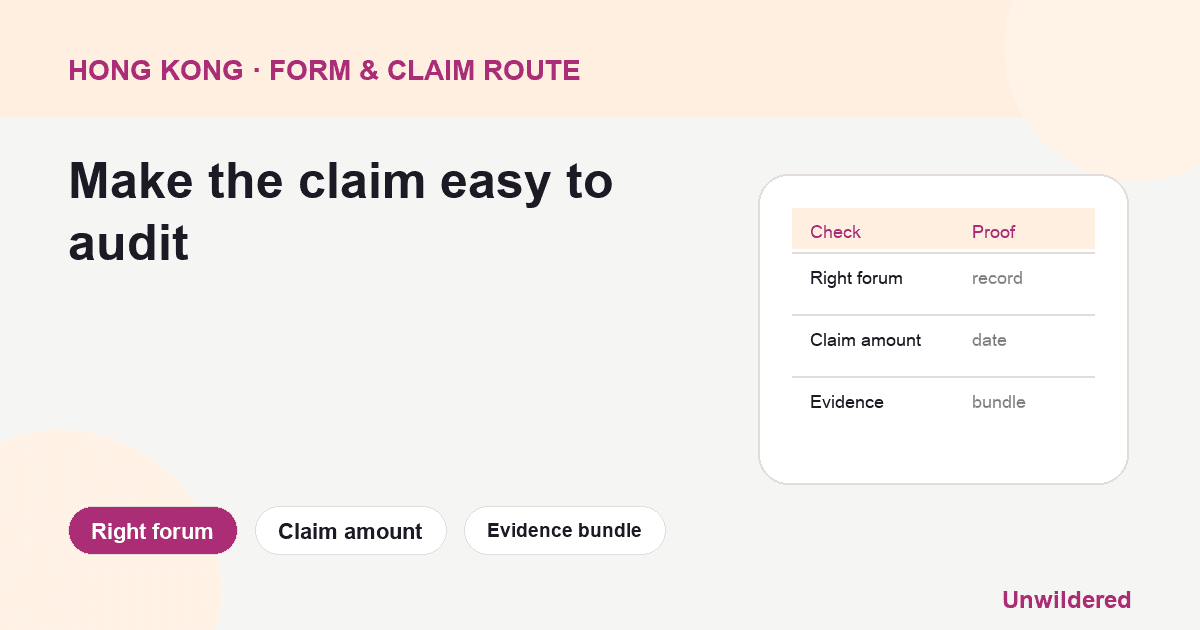
The Hong Kong Small Claims Tribunal is often mentioned when a tenant wants a rental deposit back, a consumer wants a refund, or a small contract dispute has stalled. The practical issue is not only whether the Tribunal exists. It is whether the claim fits the Tribunal, whether the respondent is named correctly, and whether the form tells a clear money story. The Judiciary’s Small Claims Tribunal and forms pages are the official starting points, and the Judiciary sample rental-deposit claim is useful for seeing how a deposit dispute can be presented.
This guide is for form preparation. It does not decide whether your claim will succeed. Before filing, check the current Tribunal page for the monetary limit, excluded claim types, filing method, fees, and procedure.
Mistake 1: filing before checking eligibility
Small Claims is not a general problem-solving counter for every dispute. Check whether your issue is a civil money claim within the Tribunal’s scope. If the problem is employment wages, a Labour Tribunal route may be relevant instead. If it concerns possession of land, building management, family matters, or a remedy other than money, the Small Claims Tribunal may not be the right forum. When the dispute is a tenancy deposit, focus on the exact sum you say is owed and why.
Mistake 2: naming the wrong respondent
The form needs the person or legal entity you are claiming against, not only a nickname, agent, building name, or WhatsApp display name. For a landlord claim, compare the tenancy agreement, stamped copy if available, receipts, bank account, agent messages, and any company information. Traditional Chinese labels that may help your file are 申索人, 答辯人, 業主, 租客, 代理, 租約, and 按金. If an agent collected money, decide whether the claim is against the landlord, agent, company, or more than one party only after checking the documents.
Mistake 3: giving a number without a calculation
The Tribunal needs to understand the amount claimed. For a rental deposit, build a short table: deposit paid, rent unpaid if any, utility balance if any, cleaning deduction disputed, repair deduction disputed, amount already returned, and net claim. Attach proof for each line. If the landlord deducted HKD 2,000 for cleaning, ask for the invoice or photos. If you accept part of a deduction, say so clearly. A clean calculation is usually stronger than a long emotional narrative.
Mistake 4: weak evidence order
Put evidence in a sequence that a stranger can follow: tenancy agreement, deposit payment proof, rent receipts, move-in condition photos, move-out condition photos, key return proof, messages asking for refund, landlord’s deduction explanation, invoices or lack of invoices, and your final demand. If messages are in Chinese, keep the original and prepare a simple English description. Do not crop screenshots so tightly that dates, sender names, or context disappear.
Mistake 5: confusing the sample with your own facts
The Judiciary sample rental-deposit claim is a sample, not a script to copy blindly. Your claim should reflect your dates, address, amount, respondent, and evidence. If your lease ended early, if the landlord alleges damage, or if the agreement was oral, your form should explain those facts. Do not add allegations you cannot prove just because another example includes them.
A pre-filing demand note
A tenant can send a short message before filing:
Dear [name], I refer to the tenancy at [address]. The tenancy ended on [date] and the keys were returned on [date]. I paid a rental deposit of HKD [amount]. Please return HKD [amount] by [date], or provide a written breakdown with supporting receipts, photos, or invoices for any deduction. I will keep this correspondence for the record.
Traditional Chinese version: 就[地址]的租約,本人已於[日期]遷出並交還鎖匙。本人曾支付租金按金港幣[金額]元。請於[日期]前退還港幣[金額]元;如你認為需要扣減,請以書面列明金額及原因,並提供收據、相片或發票等證明。
After filing, keep the file alive
Once a claim is filed, keep every Tribunal notice, hearing or call-over date, settlement message, payment proposal, and document served by the other side. If the respondent pays part of the claim, record the date, amount, and whether you still claim the balance. Good post-filing records help prevent a simple payment dispute from turning into confusion about what has already been resolved.
Where Unwildered fits
Upload the tenancy agreement, payment proof, messages, photos, deduction table, respondent details, and draft claim narrative. Unwildered can help organise the evidence pack, identify missing respondent information, and turn scattered messages into a clearer chronology before you use the official Tribunal forms.
This article is general information, not legal, financial, medical or tax advice.
