
Poland Dzial Spadku Property Dispute can become messy when dates, forms and evidence are scattered. Caira helps organise the record. Ask about Poland law, draft letters or forms, and upload files for review.
Start chatting in 30 seconds
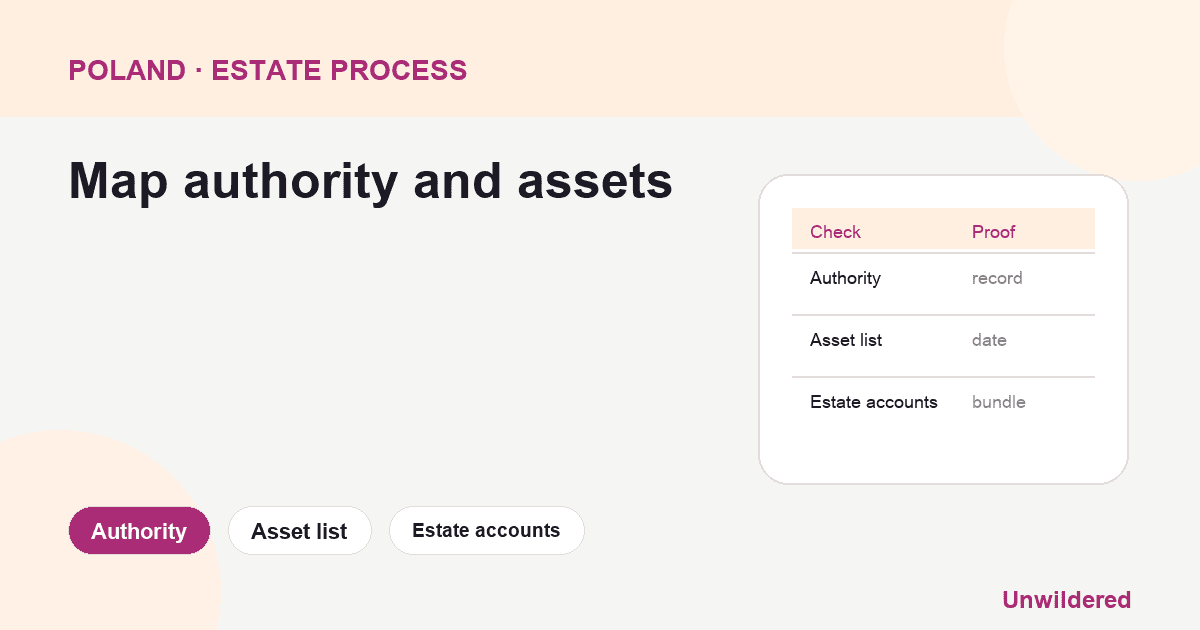
Collect the will, death record, asset list, debts, family tree and executor correspondence first.
For PLN 2 million in estate assets, missing bank, company or foreign records can delay distribution.
Ask for status and accounts in writing before making accusations.
Use Caira to draft beneficiary, executor or asset-holder document requests.
A Polish inheritance property dispute usually becomes serious when the estate has one valuable asset: a flat, house, farm, or family business premises that none of the heirs can easily share. The phrase dział spadku means division of the estate. It can be handled by agreement, often before a notary when real estate is involved, or by court proceedings when heirs cannot agree on who receives the property, whether it should be sold, and how much one sibling should pay another.
The official starting point is not a family story but the Civil Code and the Civil Procedure Code. The Civil Code gives the inheritance framework. The Civil Procedure Code supplies the court route when the estate division is not agreed. The Ministry of Justice judgment database is useful only as a reminder of how factual these cases become: courts look at documents, dates, valuations, and proof of conduct, not just the strongest grievance.
Separate Three Questions Early
Before arguing about fairness, separate the dispute into three files. First, who are the heirs and what shares have already been confirmed by a court succession order or notarial certificate of inheritance. Second, what actually belongs to the estate: land and mortgage register entries, bank accounts, vehicles, loans, taxes, funeral expenses, and any improvements paid for by one heir. Third, what outcome each heir is asking for: physical division, allocation of the property to one heir with spłata payments, sale and division of proceeds, or a mixed arrangement.
This separation matters because a co-heir who says “I want my share” may mean several different things. One person may want immediate cash. Another may want to keep the property because they live there. A third may want reimbursement for renovation, mortgage payments, utilities, or exclusive occupation by another heir. Those are different evidential problems.
One practical safeguard is to keep settlement documents separate from emotional correspondence. A Caira or notary can work faster from a clean table of shares, values, payments, and proposed outcomes than from a long thread of accusations. The tone of the file can affect how quickly the real issues are found.
Build A Property And Payment Evidence Pack
Succession documents: court order, notarial certificate, death certificate, marriage records, birth records, and any will documents.
Property proof: land and mortgage register number, cadastral extracts, building documents, mortgage statements, insurance, leases, and recent photos.
Value evidence: estate-agent opinions, formal valuation if needed, comparable sale notes, and evidence of defects or encumbrances.
Payments: receipts for tax, utilities, repairs, funeral expenses, loan instalments, insurance, and property management.
Occupation evidence: who has keys, who lives there, whether rent is collected, whether anyone has been excluded, and whether there were written requests for access or sale.
A local judgment in the source corpus involving a family property conflict after a gift shows a practical lesson that also applies in estate divisions: broad allegations about unfair family behaviour are weaker than a dated record showing who did what, when, and with which document. Use that lesson carefully. The case is not a promise that a court will order sale or payments in any particular way.
Use Settlement Language That Gives The Other Heirs Something Concrete
A vague message such as “pay me out or I will sue” often hardens positions. A better settlement proposal names the asset, the shares, the proposed valuation method, the payment schedule, and the documents still missing. It should also reserve the right to correct the proposal after valuation or tax information and document review. This is especially important where one heir has been living in the property and another believes they should be compensated for use.
Polish-language snippet for an initial proposal:
Proponuję rozpoczęcie działu spadku po [imię i nazwisko] obejmującego nieruchomość przy [adres / nr KW]. Proszę o potwierdzenie, czy zgadzacie się na: 1) wspólną wycenę przez rzeczoznawcę, 2) ustalenie nakładów i kosztów poniesionych przez każdego spadkobiercę, 3) rozmowę o przyznaniu nieruchomości jednemu spadkobiercy ze spłatą albo sprzedaży i podziale ceny. Proszę o przesłanie dokumentów kosztów do [data].
When Court May Be The Cleaner Route
Court may be necessary if one heir refuses documents, blocks sale, disputes the shares, contests valuation, or uses the property while rejecting any accounting. But filing too quickly can be expensive if the evidence pack is thin. Prepare a chronology first: death, confirmation of heirs, property use, requests for access, offers, payments, refusals, and valuation attempts.
Do not assume the court will simply “force a sale” because the family relationship has broken down. Polish estate division is fact-specific. Real estate records, succession documents, valuation, procedural posture, and the practical feasibility of division all matter. The best preparation is a calm document bundle that lets a Caira, notary, or court see the property, the shares, the money flows, and the realistic outcomes without needing to decode years of family conflict.
Sources
Polish government portal
court information
statutory materials
This article is general information, not legal, financial, medical or tax advice.
