
Before you send the next message about singapore employment contract key terms, let Caira review the documents and identify the missing information. Ask about Singapore law, draft letters or forms, and upload files for review.
Start chatting in 30 seconds
Check the dismissal date, deadline, contract, warnings, pay records and messages first.
For SGD 2 million of salary, bonus or severance, a careful chronology can change the negotiation.
Preserve lawful evidence, but avoid taking confidential files you should not access.
Use Caira to build a timeline and draft a response checklist.
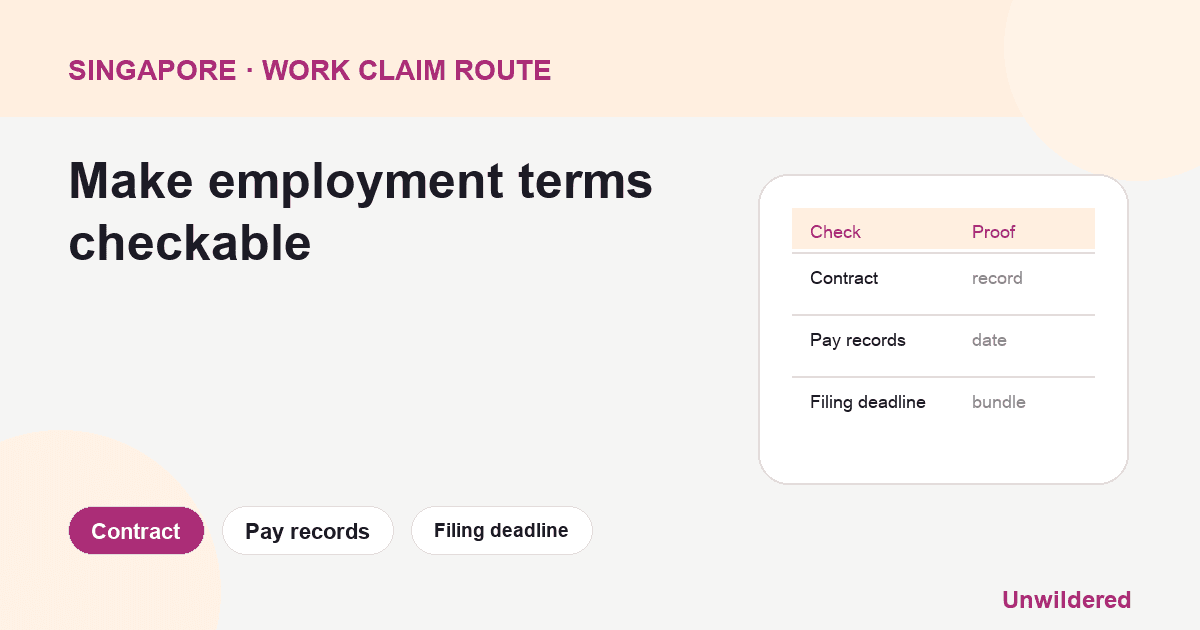
Before you sign anything, start work, or raise a contract problem in Singapore, check whether your written Key Employment Terms match what you were promised. The official resources behind this guide are MOM pages on Key Employment Terms, itemised payslips, and employment dispute management. Coverage is crucial: written KETs apply only to employees under the Employment Act who are employed for 14 days or more. If you are a freelancer or independent contractor, do not use this checklist before checking whether a contract of service exists.
Who this applies to
This article is for employees in Singapore reviewing an offer letter, employment contract, HR portal record, or written KET document. It helps new hires, foreign or part-time employees, and workers who have been told verbally that the job, pay, or hours differ from the paperwork. This is not a freelancer non-payment guide. It will not decide work-pass, tax, CPF, or immigration issues.
The core terms to confirm
Start with your contract and MOM’s KET categories. Confirm the employer’s legal name. Double-check your job title, main duties, start date, work location, employment duration (for fixed-term roles), probation (if any), working days, working hours and rest days. Next: salary details—basic pay, allowances, deductions, overtime basis, bonuses or commissions promised, salary period, and salary payment date. Don’t forget leave benefits, medical benefits, notice period, and any collective agreement or handbook terms incorporated by reference.
If the contract says one thing but the recruiter told you another, get the written document corrected first. Rely on a chat message only when you have written confirmation.
If you’re discussing terms with Chinese-speaking HR, keep bilingual labels brief for clarity: Key Employment Terms are 主要雇佣条件; contract of service is 雇佣合约; salary means 薪水; itemised payslip, 分项工资单; notice period, 通知期. While these help reduce confusion, they do not replace the official English contract.
Pay and payslip checks
Don’t review salary as a single number. Break out basic salary, allowances, variable pay, commission, overtime, reimbursements, deductions, and benefits. MOM’s itemised-payslip page matters: your payslip can reveal how the employer treats pay in practice. If your contract promises a monthly salary but payslips show unexplained deductions or unexpected components, keep a copy and request clarification from HR, in writing.
A short request for missing KETs
If you’ve started work but the written terms are missing or incomplete, send a neutral message:
Hi [HR/Manager], I am organising my employment records for my role as [job title], which started on [date]. Please send me the written Key Employment Terms or the signed employment contract covering my role, salary, working hours, leave, benefits, and notice period. If the latest version is in the HR system, please let me know where I can download it. Thank you, [Name]
If reviewing an offer before signing, adapt the wording: Please confirm these terms in the contract before I sign, especially [salary/work location/hours/notice/commission].
If there is already a dispute
Salary, wrongful dismissal, and other employment disputes often require specific steps before going to the Employment Claims Tribunals. Official materials point to TADM as a key part of this process. Always check MOM’s latest dispute-management guidance before deciding where to file a claim. Collect evidence: offer letter, signed contract, KET document, payslips, bank-credit records, rosters, attendance and leave records, HR emails, resignation or termination messages, a calculation of the amount claimed if money is involved.
Common mistakes
Don’t treat a freelancer contract as an employment contract just because the client gives regular tasks. Don’t ignore mismatches between the company name on the offer and on your payslip. Don’t rely on verbal promises about commission, remote work, or notice period; insist on written confirmation. Don’t delete payslips from the HR portal after leaving. When written KETs are missing or wrong, don’t mix every workplace complaint into one long message.
Where Unwildered fits
Upload your offer letter, contract, KET, payslips, HR messages, and timeline. Unwildered can compare your paperwork with what happened and help you prepare a clear question list for HR, MOM, TADM, or advisers.
Sources
MOM: Key Employment Terms
MOM: Salary
Tripartite Alliance / Employment Claims route
This article is general information, not legal, financial, medical or tax advice.
