
Singapore Tenant Airbnb Rented Flat can become messy when dates, forms and evidence are scattered. Caira helps organise the record. Ask about Singapore law, draft letters or forms, and upload files for review.
Start chatting in 30 seconds
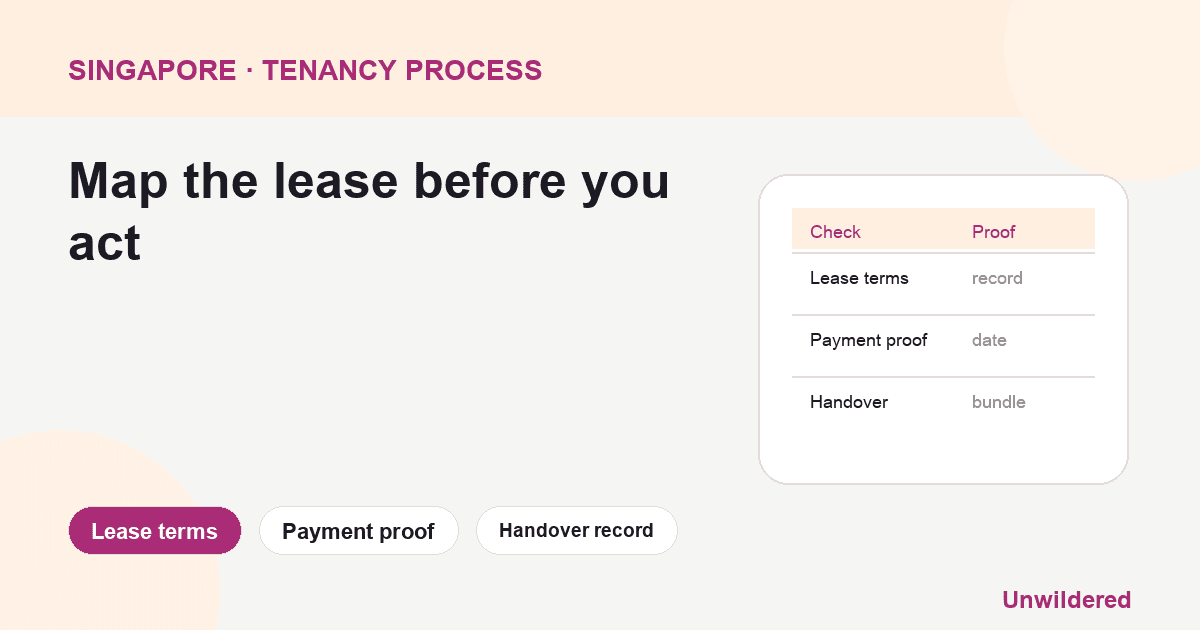
Keep the contract, deposit proof, inventory, photos, messages and payment records together.
For SGD 2 million in rent, repairs or risk of losing the deposit, small missing evidence can matter.
Separate what the agreement says from what actually happened.
Use Caira to draft a landlord, tenant or tribunal-ready document checklist.
A Singapore tenant should be very cautious before putting a rented flat, room, or condo unit on Airbnb or another short-stay platform. The issue is not only whether the tenancy agreement says no subletting. Singapore has official short-term accommodation rules, HDB-specific rules, owner responsibilities, and practical contract risks. The correct answer depends first on the property type: HDB flat or bedroom, private residential property, serviced apartment, hotel-style accommodation, or another category.
This guide is for tenants thinking about short-term guests in a rented home. It does not explain how to run a licensed accommodation business, and it does not promise that landlord consent alone solves the official-rule problem.
Identify the property type first
Start with the address and property status. Is it an HDB flat, an HDB bedroom rental, a private condo, a landed house, or another residential property? HDB and private residential properties are not reviewed under the same source family. HDB official pages point tenants and estate agents to HDB rental regulations, including restrictions around renting out flats or bedrooms and non-residential use. URA is the official main reference point for private residential short-term accommodation.
If you do not know the property type, stop before listing anything. Check the lease, landlord messages, property listing, and official property information. A platform category is not the legal category.
Check the official short-term rules
For private residential property, the URA short-term accommodation source is the key page to read before any listing. For HDB, use HDB’s current rules for whole-flat and bedroom rental. The editorially safe position is that Singapore official rules are strict enough that a tenant should not assume Airbnb-style stays are allowed. Minimum-stay, approval, occupancy, and use restrictions can matter, and rules may differ by property type.
Do not rely on comments such as everyone does it, the landlord will not know, or the platform accepted the listing. Platform acceptance is not official approval. Landlord silence is not the same as written consent and official compliance.
Read the tenancy agreement
Most tenancy agreements include clauses on subletting, assignment, licensing, permitted occupiers, residential use, guest stays, nuisance, insurance, management rules, and compliance with law. A short-term listing may breach more than one clause. Even if the agreement does not use the word Airbnb, it may prohibit subletting, paying guests, unauthorised occupiers, business use, or licence arrangements.
Check whether the agreement requires written landlord consent before any subletting or occupation by another person. If the property is a condo, check management by-laws or house rules too. A landlord’s casual WhatsApp message may not be enough for a high-risk arrangement.
Why landlord consent may not be enough
Tenants often ask whether written landlord consent makes Airbnb acceptable. It may solve one contract issue, but it does not automatically answer URA, HDB, management, insurance, tax, neighbour, or building-use questions. The owner may also have obligations or risk if the unit is used in a way the official rules do not allow. That is why the safer question is not can I get permission after listing, but what official route permits this property and this stay length?
If the answer is unclear, do not host. Save the official page and ask the landlord or a Caira a precise question before money changes hands.
Evidence to preserve if a dispute has started
If the landlord, agent, condo management, HDB, URA, or neighbours have already raised concerns, preserve the listing, booking records, guest messages, stay dates, payments, tenancy agreement, landlord consent if any, house rules, warning letters, and screenshots of the official pages you relied on. Do not delete listings or chats in a way that makes the evidence trail worse. If you remove the listing, save a record of when and what was removed.
Separate money issues from compliance issues. A landlord may allege breach, damage, nuisance, extra utilities, management penalties, or early termination. Each needs its own evidence.
A cautious message to the landlord
Hi [Landlord/Agent], I am checking whether any short-term guest arrangement is allowed for [address]. Before I take any step, please confirm in writing whether the tenancy agreement, property rules, and applicable HDB or URA requirements allow this. If it is not allowed or requires approval, I will not proceed. Please also share any building or management rules that apply. Regards, [Name]
For Simplified Chinese: 您好,我想确认位于[地址]的房屋是否允许任何短期住宿或转租安排。在采取任何行动前,请书面确认租约、物业规则以及相关 HDB/URA 要求是否允许。如不允许或需要批准,我不会继续进行。
Common mistakes
Common mistakes include treating guest stays as harmless because they are short, listing an HDB room without checking HDB rules, assuming private condo rules are the same as HDB rules, relying on verbal consent, ignoring condo management rules, and using a platform calendar as proof of legality. Another mistake is trying to regularise the arrangement only after complaints begin. By then, the landlord may already view the issue as breach evidence.
Where Unwildered fits
Upload the tenancy agreement, property type details, proposed listing, landlord messages, HDB or URA page screenshots, condo rules, and any warning letter. Unwildered can help identify the contract clauses and official-rule questions to resolve before you host or respond to a complaint.
Official context to check
For HDB and rental pages, official datasets can add market context without turning the article into a valuation report. Singapore open-data HDB rental and resale datasets are useful for checking town, flat type and market background; the user’s own lease, receipt and messages still decide the dispute file.
Sources
URA and HDB short-stay guidance
Singapore Courts: Small Claims Tribunals
Singapore Statutes Online
This article is general information, not legal, financial, medical or tax advice.
