
Before you send the next message about south africa deceased estate reporting 2, let Caira review the documents and identify the missing information. Ask about South Africa law, draft letters or forms, and upload files for review.
Start chatting in 30 seconds
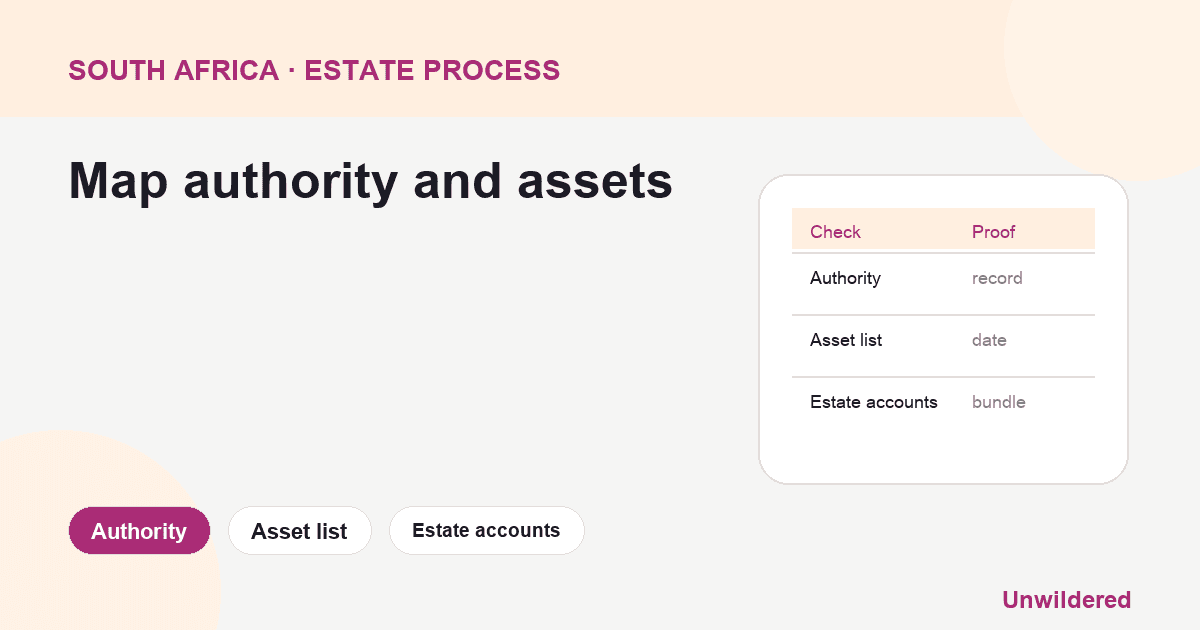
Collect the will, death record, asset list, debts, family tree and executor correspondence first.
For R10 million in estate assets, missing bank, company or foreign records can delay distribution.
Ask for status and accounts in writing before making accusations.
Use Caira to draft beneficiary, executor or asset-holder document requests.
Reporting a deceased estate in South Africa is not one single form. It is a document pack and a branching process through the Master of the High Court or a service point. The right pack depends on facts such as the estate value, whether there is a will, marital status, who is being nominated to administer the estate, and which Master’s Office or service point is responsible. The safest first step is to collect the facts before you try to complete every form you find on the Department of Justice website.
Start with the official reporting route
The official Master pages and gov.za service page are the anchors for this workflow. They explain that a deceased estate must be reported to the relevant Master’s Office or service point, and the official materials highlight the 14-day reporting point as a claim to check against the current official page. Do not rely on a forwarded form pack from another family unless your facts match. A small estate, an estate with immovable property, a disputed will, or an estate where no will can be found can all need different handling.
Core documents to collect first
Before forms, gather the evidence. Start with the death certificate, the deceased person’s ID document, your own ID, proof of address where requested, and contact details for close relatives. Add the original will if one exists, any codicil, marriage certificate, divorce order, antenuptial contract if available, and details of a surviving spouse. If there is no will, prepare next-of-kin information carefully because the official affidavits and nominations may depend on it.
You should also collect a basic asset and liability list: bank accounts, policies, pension or provident details, vehicle papers, property details, bond statements, loans, funeral accounts, medical bills, municipal accounts, and any business interests. This is not about guessing the final estate value. It is about giving the Master enough organised information to identify the route and the person who should act.
Forms you may see
Common labels in this area include J294, J192, J243, J190, inventory, next-of-kin affidavit, nomination of executor or representative, acceptance of trust as executor, letter of executorship, and letter of authority. Afrikaans searchers may use words such as boedel, oorlede boedel, eksekuteur, and boedelbereddering. Treat these as navigation terms, not proof that every form applies to your case.
A letter of executorship and a letter of authority are not interchangeable paperwork decorations. They relate to who is authorised to administer the estate in the relevant route. If you are unsure which one is likely, avoid filling in assumptions and ask the Master’s Office or a Caira before signing.
Make a clean document pack
Build the pack in sections: identity and death documents, family and marital documents, will documents, assets, liabilities, nominated representative documents, and correspondence. Label files by date and description. If you are submitting paper copies, keep a full copy of exactly what was handed in. If you email or upload anything, save the sent record and any reference number.
Where documents are missing, write down the truth. Missing original will, unknown bank account, uncertain marital status, or family disagreement are not problems you solve by guessing. They are issues to flag because they can change what the Master asks for.
Short request message
Use a neutral message when asking relatives for documents:
Subject: Documents needed to report the deceased estate
Dear [Name], I am preparing the documents needed to report the estate of [deceased name] to the Master of the High Court. Please send any documents you have relating to the death certificate, ID, original will, marriage documents, bank accounts, policies, property, debts, funeral account, or next-of-kin details. If you are not sure whether something is relevant, please send the description first. Kind regards, [Name]
Afrikaans if useful: Ek berei die dokumente voor om die boedel van [naam] by die Meester van die Hooggeregshof aan te meld. Stuur asseblief enige dokumente oor die doodsertifikaat, ID, testament, huweliksdokumente, bates, skuld of naasbestaandes.
Common mistakes
Do not submit a photocopy where the process asks for an original will. Do not leave out marital documents because the family already knows the relationship. Do not invent an estate value without supporting asset information. Do not nominate someone without checking whether they are willing to act. Do not assume the same form pack applies to every Master’s Office or service point. And do not present this checklist as legal information and document review where there is a disputed will, missing heir, insolvent estate, or conflict between relatives.
Where Unwildered fits
Upload the will, death certificate, ID documents, marriage papers, asset list, debt records, family details, and any draft Master forms. Unwildered can help turn the file into a document checklist and flag missing branches before you use the official Master workflow.
Sources
Master of the High Court
Department of Justice
Administration of Estates Act materials
This article is general information, not legal, financial, medical or tax advice.
