
For south africa rental deposit interest, the strongest first move is usually a clear file. Caira can help build it from uploads. Ask about South Africa law, draft letters or forms, and upload files for review.
Start chatting in 30 seconds
Keep the contract, deposit proof, inventory, photos, messages and payment records together.
For R10 million in rent, repairs or risk of losing the deposit, small missing evidence can matter.
Separate what the agreement says from what actually happened.
Use Caira to draft a landlord, tenant or tribunal-ready document checklist.
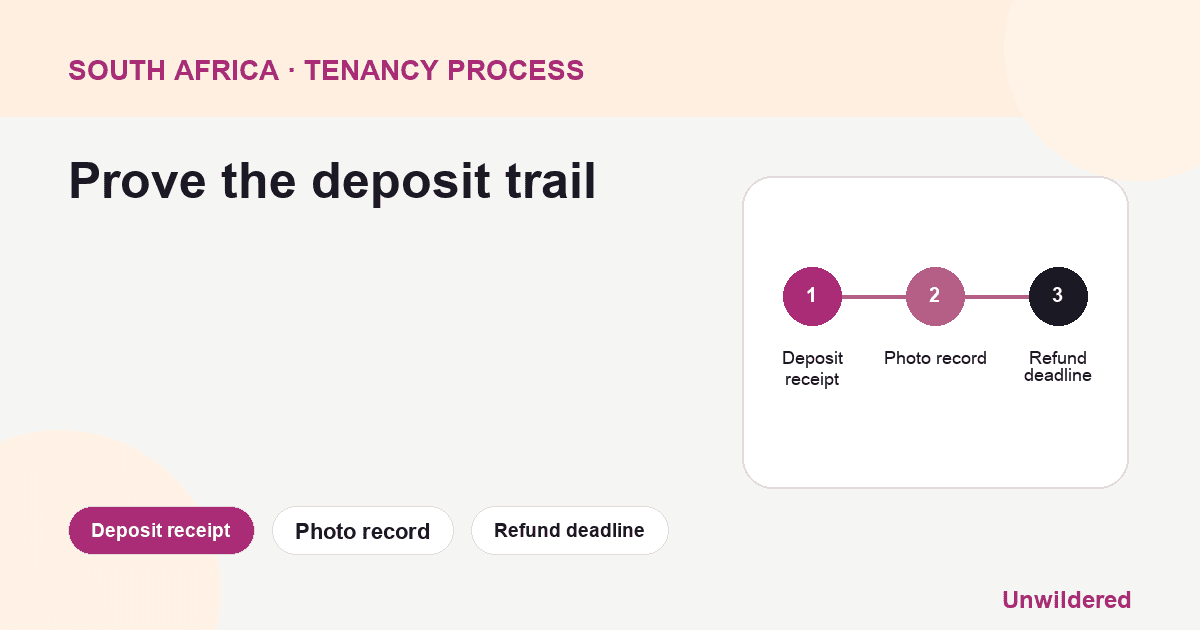
In South Africa, a rental deposit should not be treated as extra rent that disappears into a landlord’s ordinary spending. The official Rental Housing Act materials support the basic deposit-interest spine: the deposit should be invested in an interest-bearing account, and the tenant can ask for proof of the interest that has accrued. The practical challenge is usually not the headline rule. It is getting a clear calculation, separating interest from lawful deductions, and keeping enough evidence to show what was paid and what remains due.
Start with the deposit clause
Open the lease and find the clause dealing with the deposit. Check the deposit amount, when it was paid, whose account received it, whether an agent handled the money, what the deposit may cover, and what the lease says about return after the tenancy ends. The national rule is the main reference point, but the lease and facts still matter because the landlord may claim unpaid rent, utilities, missing keys, damage, or other amounts. Interest is not a shortcut around those disputes.
If an estate agent or managing agent held the money, do not assume the same bank account rules apply in the same way without checking the documents and asking who actually held the deposit. Your first request should be factual: where was the deposit held, what interest accrued, what deductions are claimed, and what balance is being returned?
Ask for written proof
A tenant can make a simple written request for proof of interest and a deposit statement. Keep the tone neutral because you may later attach the message to a tribunal complaint or evidence pack:
Subject: Request for deposit and interest statement
Dear [Landlord/Agent], I am writing about the rental deposit for [address]. I paid a deposit of R[amount] on [date]. Please provide a written statement showing where the deposit was held, the interest accrued, any deductions you intend to make, and the balance to be returned. If you rely on any deduction, please include supporting invoices, quotes, inspection reports, photographs, or account statements. Kind regards, [Name]
Afrikaans version if useful: Geagte [Verhuurder/Agent], ek skryf oor die huurdeposito vir [adres]. Ek het R[bedrag] op [datum] betaal. Verskaf asseblief ‘n skriftelike staat wat wys waar die deposito gehou is, watter rente opgehoop het, enige aftrekkings, en die balans wat terugbetaal moet word.
Do not confuse interest with deductions
Deposit interest and deposit deductions are related, but they are not the same question. Interest is about what the deposit earned while held. Deductions are about what the landlord says is owed after the tenancy. If the landlord says the whole deposit was used for damage, ask for the inspection records, photos, invoices, and lease clause. If the landlord admits a balance is due but omits interest, ask for the interest calculation separately.
If rent or utilities are genuinely outstanding, account for those amounts instead of demanding a full deposit as if nothing else happened.
Evidence to keep
Your file should include the signed lease, deposit receipt, bank transfer proof, rent ledger, incoming inspection report, outgoing inspection report, move-in photos, move-out photos, key-return proof, utility bills, repair requests, landlord deduction list, invoices, quotes, and every message asking for the deposit statement. If there was no inspection, keep messages showing whether it was requested, scheduled, refused, or missed.
For interest, keep the amount paid, the date paid, the date the tenancy ended, the date keys were returned, and any statement from the landlord or agent. A calculation is easier to check when the dates are clear.
When the Tribunal may be relevant
If the landlord refuses to provide a statement, will not return the balance, or gives unsupported deductions, check the Rental Housing Tribunal route for the province where the property is located. The national Act is the legal main reference point, but filing is practical and province-specific. Western Cape and Gauteng have their own official materials. A tenant in another province should use that province’s current official route instead of copying a Western Cape or Gauteng form.
Common mistakes
Do not ask only for my deposit back if the dispute is really about a missing interest calculation. Do not invent an interest rate in your demand letter unless you can support it from the account information or official source. Do not ignore a deduction just because interest is owed. Do not delete WhatsApp messages after the landlord sends a vague reply. And do not treat the deposit as last month’s rent without checking the lease and getting advice on your facts.
Where Unwildered fits
Upload the lease, deposit proof, inspection records, photos, bank statements, and landlord messages. Unwildered can help organise the deposit amount, interest request, deduction evidence, and province-specific next-step questions before you contact the landlord, agent, tribunal, or adviser.
Official context to check
For South African rental pages, the useful official angle is usually procedural rather than statistical: deposit handling, interest, inspections and the correct provincial tribunal route matter more than national rent averages.
Sources
Rental Housing Act
provincial Rental Housing Tribunal
Department of Justice: Small Claims Court
This article is general information, not legal, financial, medical or tax advice.
