
If south africa tax board vs tax court is on your desk, upload the notice, agreement, order or correspondence to Caira first. Try asking specific South Africa law questions, draft letters or forms, or send documents for review.
Start chatting in 30 seconds
Preserve notices, returns, invoices, bank records, and internal messages before anyone begins to explain the file. Do this early.
Where R10 million or more is on the line, the timeline and source documents are just as important as the tax amount itself.
Separate what is known from what is missing. Clarify exactly what the authority is asking for before deciding what to send.
Use Caira to generate a document hold list and draft clear, focused response points.
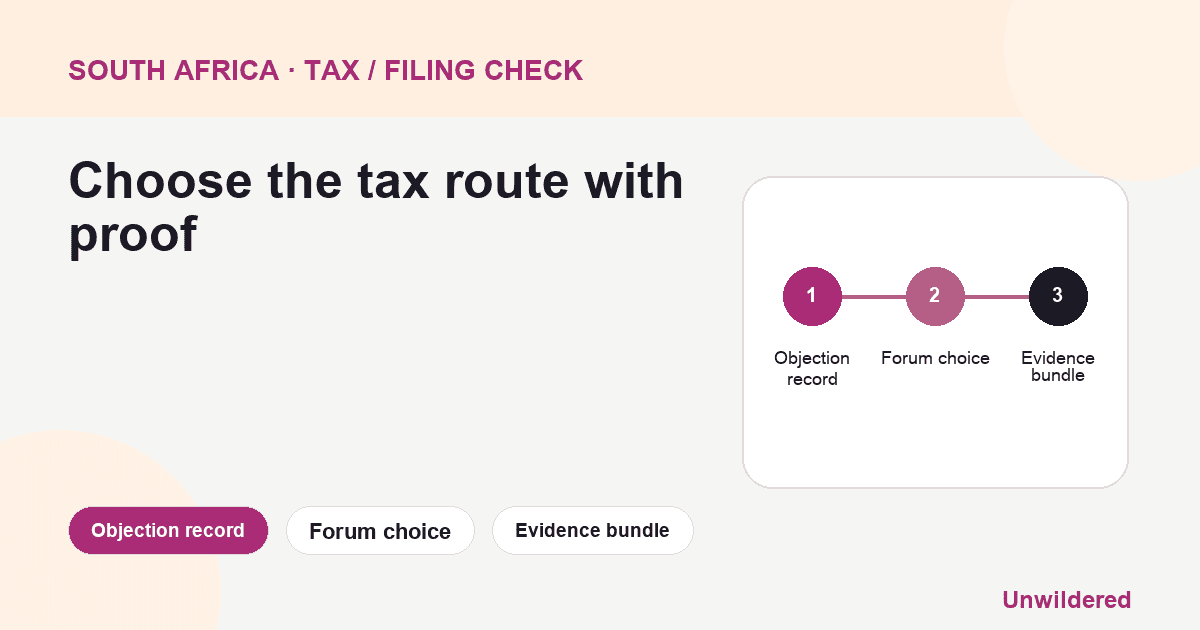
When SARS rejects an objection, many taxpayers immediately look for the Tax Court as their next step. That reaction may be too hasty. In South African tax disputes, the usual route is more structured: start by understanding the assessment, request reasons if anything is unclear, lodge an objection if grounds exist, and only then decide on your appeal approach. There may be further steps, such as alternative dispute resolution, the Tax Board, or finally the Tax Court, depending on the case.
Picking the wrong route or misunderstanding the process can lead to missed deadlines—and evidence that isn’t ready when it counts.
SARS official dispute guidance, as well as the eFiling guide, should be your first procedural reference. The South African Judiciary’s material shows where courts fit into the broader system, while SAFLII judgments give useful examples of tax appeals in litigation. Remember, forum choice isn’t about branding. The right forum depends on the amount in question, complexity, legal questions, evidence, and dispute rules at that moment.
The sequence before forum choice
The first real decision: do you fully understand why SARS made the assessment? If not, start by requesting reasons. If you have sufficient detail, submit a thorough objection, clearly identifying the grounds and supporting it with evidence. A weak objection is not easily fixed later. Make sure to spell out what SARS got wrong, reference your supporting documents, and state the result you’re seeking.
After SARS rules on your objection, take stock. Should you accept, narrow the issue, or appeal? An appeal isn’t just the previous objection with more passionate language. Go further—set out the issues still in dispute, highlight the facts you can prove, explain your legal interpretation, and choose the forum or process equipped to tackle those concerns.
ADR, Tax Board, and Tax Court
Alternative dispute resolution (ADR) often helps if both parties want to focus the issues or settle without a formal hearing. It works well when the disagreement hinges on valuation, timing, documentation, classification, apportionment, penalty basis, or interpretation. However, ADR isn’t a shortcut if you lack core records, nor is it a guarantee that SARS will compromise.
The Tax Board generally handles smaller or less complex appeal matters. Its process is less formal than the Tax Court’s, yet that’s not a licence to show up unprepared. For higher-value, complex, or highly legal disputes, the Tax Court is almost always the better fit. Sometimes, the issues demand the rigor and formality of the Tax Court regardless of taxpayer preference. Always check current SARS dispute rules, along with any monetary or issue-based thresholds, before settling on a forum.
Route-selection checklist
Assessment type: income tax, VAT, PAYE, customs, penalty, interest, or any mix of these.
Procedural stage: assessment, reasons, objection, outcome on objection, appeal, ADR, board, or court.
Amount in dispute—consider whether penalties or understatement penalties are included.
Key issue: documentation, accounting treatment, law, valuation, timing, residence, or a fraud allegation?
Evidence: Are contracts, invoices, ledgers, bank statements, tax computations, expert reports, and witnesses ready and available?
Deadlines: Compile a calendar, drawing from the SARS notice and dispute rules. Save proof of service and eFiling where relevant.
Another essential question: Do payment, suspension of payment, or collection risk need immediate attention? Remember, disputing an assessment doesn’t freeze SARS’s collection powers. If collection steps have started, align your dispute and payment strategy—avoid letting one unravel the other.
How to prepare the file
Prepare a hearing file even if ADR still looks possible. Begin with a chronology: map the transaction, the original tax return, SARS queries, responses, assessment, objection, and decision. Next, build an evidence index. Each disputed issue should link to at least one document. If the question is whether expenditure is deductible, tie together the contract, invoice, proof of payment, business purpose, and accounting treatment. For VAT input tax, reference supplier data, the tax invoice, delivery or service evidence, payment, and due diligence checks.
Don’t flood the file with every bank statement or stray email. A concise index always beats a warehouse of documents. Separate legal arguments from factual evidence—both are needed, but blurring the two just makes your case harder to follow.
When to escalate
Act fast if your dispute involves a significant amount, includes possible fraud allegations, touches on complex structures, transfer pricing, trusts, cross-border issues, criminal risk, or sets a precedent for future years. While Tax Board routes can be more affordable, broader legal consequences may demand the Tax Court’s greater formality.
The goal isn’t to predict which forum guarantees a win. It’s to match the route to the dispute and safeguard every deadline along the way. If you can summarise the assessment, objection result, live issues, evidence, amount, and preferred forum on one page, your next adviser can engage more efficiently—and you’re far less likely to make avoidable missteps.
Sources
Department of Justice court guidance
court rules and forms
This article is general information, not legal, financial, medical or tax advice.
