
Before you send the next message about south africa unfair dismissal ccma, let Caira review the documents and identify the missing information. Ask about South Africa law, draft letters or forms, and upload files for review.
Start chatting in 30 seconds
Check the dismissal date, deadline, contract, warnings, pay records and messages first.
For R10 million of salary, bonus or severance, a careful chronology can change the negotiation.
Preserve lawful evidence, but avoid taking confidential files you should not access.
Use Caira to build a timeline and draft a response checklist.
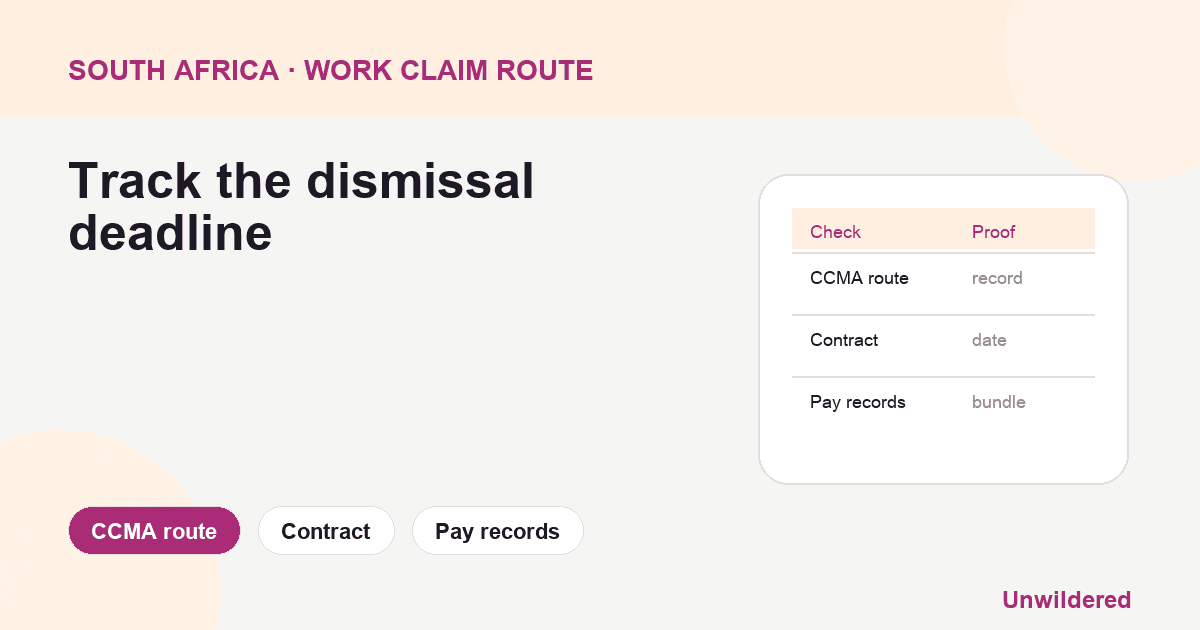
If you have been dismissed in South Africa, the CCMA route is often urgent before it is complicated. The key first question is not whether the dismissal feels unfair. It is when the dismissal happened and whether the unfair dismissal dispute can still be referred on time. The CCMA materials for unfair dismissal and unfair labour practice disputes point users to the referral process, and the widely used rule of thumb is strict: unfair dismissal referrals are usually measured against a 30-day period from dismissal or from the employer final decision.
Do not wait for the employer to send a nicer letter, finish an internal conversation, or respond to a long grievance if the referral clock is already running. Internal appeals, negotiations, or requests for reasons may be useful, but they do not always protect the CCMA deadline. If the date is close, prepare the referral and get advice quickly.
What Counts As The Dismissal Date
The dismissal date can be obvious where the employer gives a termination letter saying employment ends immediately. It can be less obvious where there is a disciplinary outcome, internal appeal, resignation under pressure, fixed-term contract ending, constructive dismissal allegation, or a final decision communicated later. Record every date: suspension, disciplinary hearing, outcome letter, appeal submission, appeal result, last day worked, final pay, and return of company property.
The referral should match the dispute. A misconduct dismissal, incapacity dismissal, operational-requirements dismissal, probation dismissal, constructive dismissal, or non-renewal dispute may need different facts and documents. Labelling the dispute incorrectly can create confusion at conciliation. If you are unsure, say what happened in plain language and preserve the documents.
If You Are Late
A late referral normally requires condonation. Condonation is not a rubber stamp. You may need to explain the length of delay, the reason for each period of delay, prospects of success, prejudice, and the importance of the matter. A short delay with clear proof may be easier to explain than a long delay justified only by I was busy or I hoped HR would fix it.
Build a delay chronology before completing any condonation affidavit or form. Include hospital records, union communications, emails to the employer, attempts to obtain documents, load-shedding or access issues only where they truly prevented action, and the date you first learned about the CCMA route. Do not overstate. A candid explanation is safer than a dramatic one that falls apart under questioning.
Evidence For Conciliation
Conciliation is a settlement-focused process. The commissioner may not decide the merits that day, but preparation still matters. Bring the employment contract, payslips, disciplinary notice, charge sheet, hearing minutes, outcome, appeal papers, dismissal letter, warnings, policies, messages, medical documents if relevant, and a short calculation of any compensation or reinstatement position. If you want reinstatement, be ready to explain why the relationship can still work and what changed.
Employers should also prepare. The employer may need the rule breached, investigation notes, disciplinary record, hearing proof, witness availability, consistency evidence, and reasons why dismissal rather than a lesser sanction was chosen. A bare statement that the employee was guilty is rarely enough for later arbitration.
Afrikaans Referral Checklist
Use this as a practical file label list, not as a promise that the claim will succeed:
Afdankingsdatum: laaste werkdag, briefdatum, appeldatum.
CCMA verwysing: saaknommer, vorm, bewys van betekening aan werkgewer.
Rede vir afdanking: wangedrag, onbevoegdheid, bedryfsvereistes, proeftydperk.
Bewyse: kontrak, betaalstrokies, dissiplinere kennisgewing, notules, uitkomsbrief.
Getuies: name, rol, kontakbesonderhede, wat elkeen kan bevestig.
Laat verwysing: lengte van vertraging, rede, dokumente, datum van kennis.
Keep The CCMA Route Separate From Review
A dismissed employee usually starts at referral and conciliation. A Labour Court review is a later and different process, usually after an arbitration award. Do not skip the referral stage because you have read about Labour Court review cases online. Also do not assume every workplace grievance is an unfair dismissal claim. Unpaid salary, discrimination, protected disclosure, restraint of trade, and occupational injury issues may need parallel or different routes.
SAFLII and Labour Court judgments are useful examples of how condonation and unfair dismissal disputes are assessed, but they are not templates to copy blindly. The facts that matter are your dates, your reason for delay, your documents, and the fairness issues in the dismissal.
Before You Submit
Check the employer legal name, trading name, address, email, and proof of service. Attach only what the form requires, but keep a fuller bundle ready. Save proof of submission and diarise every CCMA notice. If settlement discussions continue, mark offers carefully and avoid defamatory public posts about the employer while the dispute is active.
A timely referral does not can help reinstatement or compensation. It preserves the forum in which the dispute can be conciliated and, if unresolved, potentially arbitrated. In unfair dismissal matters, that preservation step is often the most important thing you can do in the first month.
Sources
CCMA
Department of Employment and Labour
Labour Relations Act materials
This article is general information, not legal, financial, medical or tax advice.
