ABE interviews in family court: what happens when a child changes their account?
A child says something happened. Later, they give a different account—or say it did not happen at all.
If you are facing allegations, you may feel that should settle the matter. If you are worried about a child’s safety, you may fear that everything they previously said will now be ignored.
Neither reaction tells you how the court will assess the evidence. What matters is what the child said, how the account was obtained, and how it fits with the other information available.
Whether you have a solicitor or are representing yourself, there are practical ways to identify the issues and prepare a clear response. This guide concerns England and Wales.
What is an ABE interview?
ABE means Achieving Best Evidence. The government’s guidance covers interviewing victims and witnesses, including children and vulnerable adults. It addresses preparation, communication needs and how interviews should be conducted and recorded.
Although the guidance is written for criminal proceedings, ABE interviews can also become evidence in family proceedings. An interview of a child as a witness is different from a police interview of someone suspected of an offence. Read the government’s ABE guidance.
Why this case matters
In Oxfordshire County Council v KM [2026] EWFC 310 (B), the judge criticised the preparation and conduct of interviews concerning allegations of sibling sexual abuse.
The planned approach repeatedly put earlier accounts to the children for confirmation or rejection. Their individual needs and opportunities to give their own narrative received insufficient attention.
The significant point: the interviews included denials, yet the court made abuse findings after considering the wider evidence. The interviewing organisation, Triangle, supplied a published response describing a review of its approach and cautioning against generalisation to all its interviews. Judgment, paragraphs 78–95 and 729–739, and appended response.
Start with the allegation you actually need to answer
Before examining every inconsistency, write down what is being alleged against you.
Are you accused of harming the child? Knowing about a risk and failing to protect them? Discouraging them from speaking? These may require different evidence and explanations.
A useful preparation sheet has four columns:
Allegation | Your response | Relevant evidence | What needs clarification |
|---|---|---|---|
What exactly is said to have happened, and when? | What do you accept, deny or not know? | Document name, date and page or message reference | Missing record, unclear wording or disputed chronology |
Use the allegation’s actual wording where available. Keep your response factual. Include difficult evidence as well as material that supports your position.
You can prepare this yourself. If you have a legal representative, it also gives them a clearer starting point.
What should you look for in the child’s accounts?
Use this table to organise questions. It is a preparation tool, not a way to score whether a child is telling the truth.
What to check | Why it may matter | A useful question to record |
|---|---|---|
The original words | A summary may contain an adult’s interpretation | Where are the child’s own words recorded? |
The question before the answer | An answer can be misleading without its context | Was this information volunteered or introduced in the question? |
The complete exchange | A selected sentence may omit a correction, uncertainty or explanation | What was said immediately before and afterwards? |
The timing of the record | A note made immediately and a later recollection are different sources | When was this written, and by whom? |
Communication needs | Age, language and other needs may affect understanding | How was the interviewing approach adapted? |
Changes between accounts | You need to identify precisely what changed | Is this a contradiction, an omission, extra detail or different wording? |
Supporting or conflicting material | Messages and other records may help test an account | Which existing document supports or challenges this particular point? |
The ABE guidance provides a framework for examining interview preparation and questioning. Identify the specific concern and its possible effect; a general complaint that the interview was “bad” leaves the important question unanswered. Official ABE guidance.
How to raise a concern without attacking the child
Try to describe the evidential problem precisely. For example, a preparation note might say:
“The report describes this as a direct disclosure. The note at page 42 records the child’s words differently. I ask for the original record and the surrounding exchange to be considered before a finding is made.”
Or:
“The interview extract contains a denial. I ask for the complete exchange to be considered, including the question and any explanation that followed.”
These are illustrative wording examples, not court forms. Adapt them to the actual documents and follow the court’s directions about where and when to raise the issue.
Avoid assigning motives you cannot establish. “These two records differ” identifies a point for investigation. “Everyone is lying” does not explain it.
If you do not have a solicitor
Start with the documents you already lawfully hold. Preserve original messages, emails and files, including their dates and surrounding context. Keep your working notes separate from the original evidence.
Make a short list of missing material. That might include the full interview, a transcript, the original safeguarding note or a record referred to in a report.
For each item, explain:
What it is.
Who appears to hold it.
Which disputed issue it could clarify.
Why the material already available is insufficient.
If proceedings are underway, ask the court how the request should be raised and whether directions are needed. A request does not itself give you permission to obtain, circulate or publish sensitive material.
For help presenting your own evidence, see our family court witness statement guide. Follow the directions in your case if they differ from a general template.
The legal detail: what is the court deciding?
The technical distinctions below help explain why a changed account does not produce an automatic outcome.
1. Who has to prove the allegation?
At paragraph 38, the judge confirms that the person asserting an allegation bears the burden of proving it on the balance of probabilities. The other person does not have to disprove it or supply an alternative explanation.
Paragraph 41 adds that inconsistency, delay or retraction does not itself establish truth or falsity. Oxfordshire County Council v KM.
For your preparation, separate two questions: what evidence supports the allegation, and what evidence challenges it? You can identify a gap without inventing an explanation for it.
2. Can the court consider what a child told someone else?
Yes. Hearsay is broadly an account given outside oral evidence that is relied upon to establish what it says happened. In relevant children proceedings, the Children (Admissibility of Hearsay Evidence) Order 1993 permits evidence connected with a child’s upbringing, maintenance or welfare. The Family Justice Council explains this framework in its guidance. Family Justice Council guidance.
That makes the distinction between admissibility and weight important: whether evidence can be considered is different from how persuasive it is.
If a school note is disputed, identify the problem with its wording, source or circumstances. Simply labelling it hearsay does not resolve the issue.
3. Does a flawed interview have to be disregarded?
In this case, paragraph 95 explains the effect of the deficiencies in terms of reduced evidential weight. It does not establish automatic exclusion of every flawed interview. Oxfordshire County Council v KM.
When preparing your response, connect the criticism to the evidence: which answer might have been affected, how, and why does that matter to the particular allegation?
4. Why does “failure to protect” matter if someone else allegedly caused the harm?
Under section 31(2) of the Children Act 1989, a care or supervision order requires the significant-harm threshold to be met. The harm, or likelihood of harm, must be attributable to care falling below what it would be reasonable to expect a parent to provide, or to the child being beyond parental control.
Section 31(9) includes physical and mental health, emotional development and non-physical ill-treatment within its definitions. The threshold is a necessary condition for an order, rather than an automatic instruction to make one. Children Act 1989, section 31.
If you face a failure-to-protect allegation, prepare a dated account of what you knew, when you knew it and what you did. Include requests for help, professional advice received and steps taken to protect the child.
5. Can you question witnesses yourself?
Being unrepresented does not mean you can personally question every witness.
Part 4B of the Matrimonial and Family Proceedings Act 1984, introduced by the Domestic Abuse Act 2021, prohibits cross-examination in person in specified circumstances. Practice Direction 3AB explains the procedure, including consideration of alternatives and possible appointment of a qualified legal representative for the questioning. That appointment does not necessarily provide representation for the whole case. Practice Direction 3AB.
Raise this early if a hearing will involve disputed evidence. Prepare the points you want explored and ask how questioning will be managed.
Three things to avoid
Do not try to obtain a better account from the child yourself. Repeated questioning, rehearsing answers or seeking a withdrawal can create further problems. Put evidential concerns through the appropriate professional or court process.
Do not treat one discrepancy as the whole case. Keep your attention on the particular allegations and the complete records.
Do not overlook deadlines or safeguarding arrangements. Keep a separate list of what the latest order requires, when documents are due and any arrangements you need clarified.
Help is not limited to paying privately
If you are a parent whose child is subject to care proceedings, check your entitlement to publicly funded representation before assuming you must manage alone. Family Rights Group explains that parents in care proceedings automatically receive free legal aid. Different positions apply to other family members and other types of proceedings. Family Rights Group’s guide.
How Caira Can Help
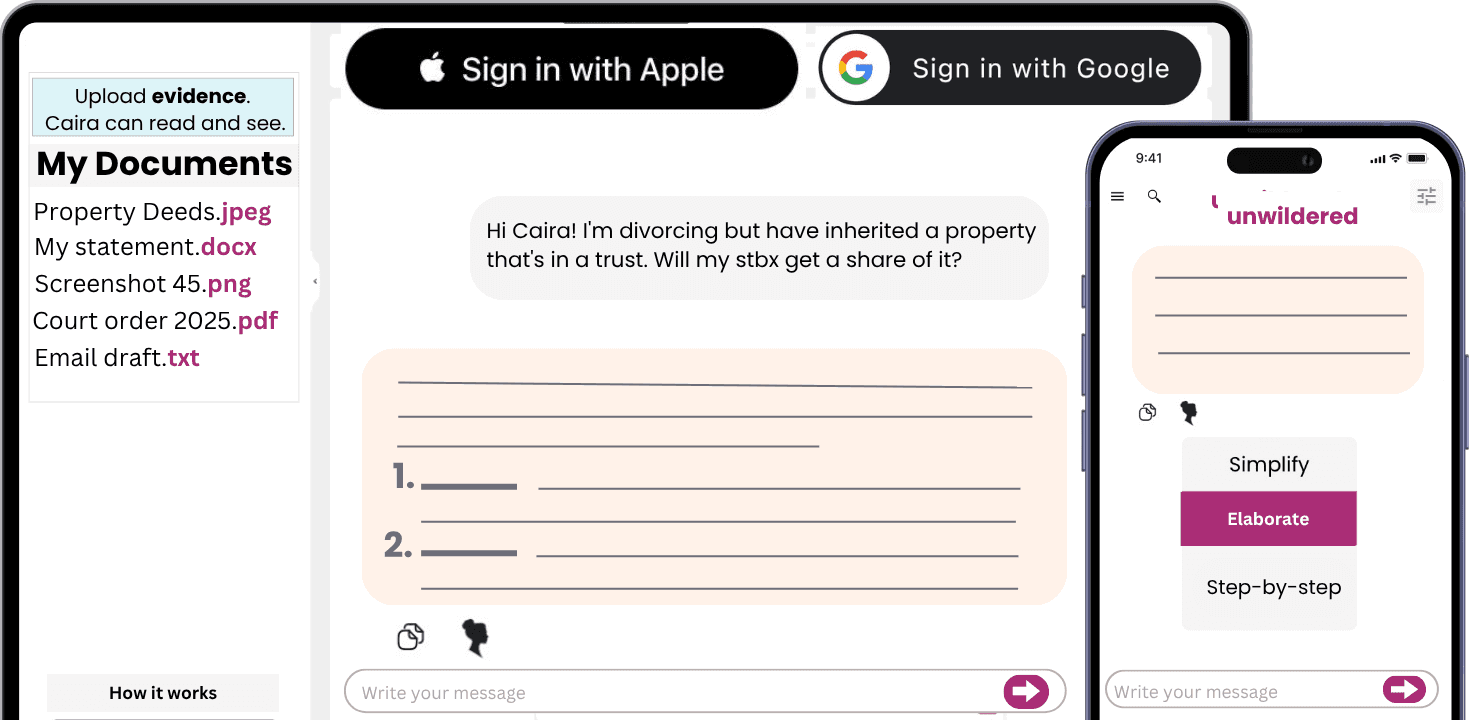
Caira by Unwildered can help you organise a chronology, compare wording across records and turn your concerns into clear questions. You can use that preparation yourself or take it to an adviser.
A useful prompt is:
“Compare these two accounts. Identify differences in wording, dates and sources. Separate the child’s recorded words from adult interpretation. Give document references and flag missing information. Do not decide who is telling the truth.”
Check every reference against the original document. Before uploading family-court material to any service, check the confidentiality rules and orders that apply to your case.
Disclaimer: This blog post provides general information for educational purposes only. It is not legal advice. Outcomes can vary based on your personal circumstances.